





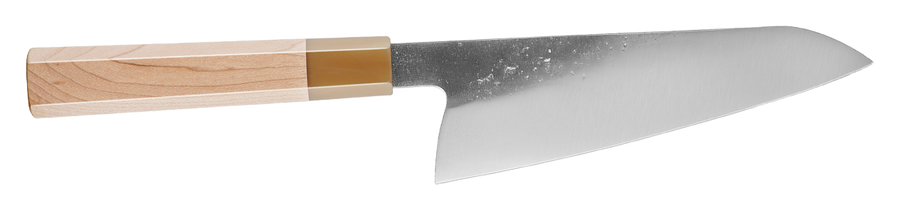

In short
- Three knives handle almost everything a home kitchen cuts: a chef's knife (or a santoku), a paring knife and a serrated bread knife.
- Add a fourth knife based on how you cook: a nakiri for vegetables, a slicing knife for roasts and the Thanksgiving turkey, a boning knife for poultry, a cleaver for herbs and garlic.
- Bought one at a time at US market median prices, those three damascus knives add up to $323.96, according to the Damascus Knife Price Survey (October 2026).
- At Damascus Knife, a matching chef, paring and bread knife from one collection costs $257 (Marea, Cobalt or Carmin), with free shipping and import duties included.
- Start with the chef's knife and add the others as you need them: you only pay for blades you actually use.
The essential kitchen knives are a chef's knife of about 8 inches (or a 7-inch santoku), a 3 to 4 inch paring knife and a serrated bread knife. Everything else, from the nakiri to the cleaver, is an add-on you buy once your cooking calls for it.
What are the three essential kitchen knives?
The three essential kitchen knives are the chef's knife, the paring knife and the bread knife. The chef's knife does most of the work on the cutting board, the paring knife takes over for anything held in the hand, and the bread knife cuts crusts and thin skins that a smooth edge slides on or crushes.
Knife makers agree on this list. Wüsthof, the German cutlery maker, says there are just three knives every kitchen needs: a chef's knife, a paring knife and a bread knife. Wikipedia's kitchen knife entry makes the same point from the other side: much of the work can be done with a few general-purpose knives, and the rest are specialists.
| Knife | Job | Typical length | At Damascus Knife |
|---|---|---|---|
| Chef's knife | Slicing, dicing, mincing, meat and fish, big vegetables | 8 to 10 in | 8 to 9.5 in, $99 to $149 |
| or santoku | Same job, push cuts, small boards | 6 to 7 in | 7 in, $99 to $149 |
| Paring knife | Peeling, hulling, coring, scoring, any in-hand work | 3 to 4 in | 3 to 3.5 in, $69 to $89 |
| Bread knife | Bread, bagels, tomatoes, citrus, cakes | 8 to 10 in | 7.5 to 8 in, $89 to $129 |

The three blades share nothing: one long, smooth and curved, one short and pointed, one serrated. That is exactly why they work as a team. Two smooth 8-inch knives, by contrast, mostly do the same job twice.
Your first knife: chef's knife or santoku?
The first knife to buy is the all-purpose one, a chef's knife or a santoku, because it makes most of the cuts in any meal. A chef's knife suits cooks who rock the blade and break down large items; a santoku suits cooks who push-cut, mostly vegetables, on a smaller board.
A chef's knife is curved so you can rock it on the board for mincing, and long enough for a whole chicken or a butternut squash. A santoku is a little shorter and nearly flat, which makes it feel compact and easy to control.
The full comparison, with real weights for our knives, is in our guide santoku vs chef knife vs nakiri. Budget is not a deciding factor here: in every Damascus Knife collection, the chef's knife and the santoku cost the same. All models are in damascus chef knives.
Paring knife or utility knife?
The paring knife is the second essential: its 3 to 4 inch blade sits close to your hand for peeling an apple, hulling strawberries or pulling the germ out of a garlic clove. A 5 to 6 inch utility knife bridges the gap to the chef's knife but does not replace a paring knife for in-hand work.
If you only buy one small knife, buy the paring knife. Your chef's knife can already mince a shallot; it cannot trim a strawberry in your palm. A utility knife earns its place if you often cut lemons, cheese or salami without wanting to pull out the big blade.
Our paring knives measure 3 inches (Cobalt, Carmin) or 3.5 inches (Marea, Cosmos, Iris). The differences between paring, utility and petty santoku are covered in our paring knife guide; the models are in damascus paring and utility knives.
Why is a bread knife one of the three?
A bread knife is one of the three essential knives because no smooth blade replaces it well: the serrated edge bites into a crust without crushing the soft inside. It also handles tomatoes, citrus, bagels and layer cakes, where a smooth edge tends to skid on the skin before it cuts.
Serrated bread knives have a long American history: Wikipedia credits Joseph E. Burns of Syracuse, New York, with a bread knife patent filed in 1919, about ten years before machine-sliced bread. The serrations work like small saw teeth, which is why they cut soft bread without squashing it.
A bread knife also spares your other knives. A hard crust puts needless wear on the fine edge of a chef's knife; giving that job to the bread knife keeps the main blade for its real work. Ours measure 7.5 inches (Cobalt, Carmin) or 8 inches (Marea, Iris, Cosmos); length, serrations and care are covered in our bread knife guide.
 Marea · Damascus Chef Knife 8"$99
 Marea · Damascus Paring Knife 3.5"$69
 Marea · Damascus Bread Knife 8"$89
 Marea · Damascus Santoku Knife 7"$99
Which knives should you add next?
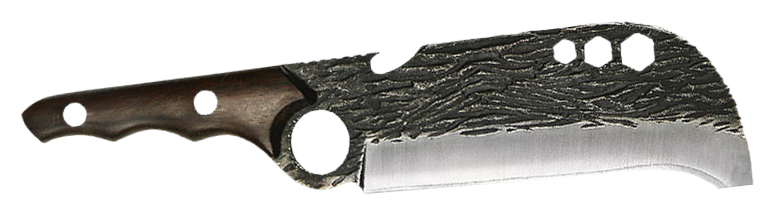
The fourth kitchen knife depends on what you cook most, not on a standard list. Lots of vegetables call for a nakiri, roasts, ham and the Thanksgiving turkey for a slicing knife, whole chickens for a boning knife, and big batches of minced herbs and garlic for a Chinese-style cleaver.
| You often cook… | Knife to add | At Damascus Knife |
|---|---|---|
| Lots of vegetables (cabbage, carrots, leeks) | Nakiri: straight edge, every slice cut clean through | 6.5 to 7 in, $99 to $149 |
| Roasts, turkey, ham, cured salmon | Slicing knife: long, narrow blade, one smooth pass | 10 in, $129 to $159 |
| Whole chickens, leg of lamb, trimming silverskin | Boning knife: narrow, pointed blade that follows the bone | 5.5 to 6 in, $79 to $99 |
| Herbs, garlic, minced meat, cartilage | Chinese-style cleaver: wide, tall blade that doubles as a scoop | 7.5 in, $99 to $139 |
| Large cuts to trim and portion (brisket, rib roast) | Butcher knife | 9 in, $129 (Iris) |
| Lemons, cheese, small jobs without the big knife | Utility knife | 5 to 6 in, $79 to $129 |
According to its product page, our cleaver handles cartilage and small, tender bones; it is not a bone chopper. Details are in our cleaver guide, and boning technique in our boning knife guide.
The one accessory worth buying early is a honing rod, which realigns the edge between sharpenings: $79 (Marea) or $89 (Iris) at Damascus Knife. It removes almost no metal; a whetstone is still what actually sharpens.
 Marea · Damascus Nakiri Knife 7"$99
 Iris · Damascus Slicing Knife 10"$129
 Marea · Damascus Boning Knife 5.5"$79
 Marea · Honing Rod 8"$79
Knife set or individual knives?
A knife set decides the lineup for you, while individual knives follow the way you cook. According to the Damascus Knife Price Survey (October 2026), a chef, paring and bread knife bought individually at US median prices add up to $323.96; at Damascus Knife, the same three cost $257 together.
Damascus Knife Price Survey · October 2026
Prices displayed on October 21, 2026 by 15 US direct-to-consumer knife brands. Damascus kitchen sets (steak, cheese and carving sets excluded): 151 sets, median $299.99; 5-piece sets $391.50 (n = 22); 6-piece sets $399.99 (n = 18). Sold individually, the median prices of the three essentials are $149 for an 8-inch chef's knife (n = 80), $69.97 for a paring knife (n = 48) and $104.99 for a bread knife (n = 36): $323.96 for all three.
What is in the box matters as much as the price. In the survey, four 3-piece sets list their knives in the product title: they combine a chef's knife, a santoku, a utility or a paring knife, and none of them includes a bread knife. Larger block sets add more knives, and often knives you will rarely reach for.
| Criterion | Knife set | Individual knives |
|---|---|---|
| Lineup | Chosen by the brand | Chosen by you, bread knife included |
| Blade lengths | Fixed | Your pick (8 to 9.5 in chef's knives here) |
| Buying | All at once | All at once or one at a time |
| US market median | depends on the number of pieces | $323.96 for chef + paring + bread (sum of medians) |
| Chef, paring and bread knife at Damascus Knife | no set | $257 (Marea, Cobalt or Carmin) |
At Damascus Knife, every knife is sold on its own, with free tracked shipping, import duties included and 30 days for a free return: you can match all three knives from one collection or mix collections. We also offer sets of 3 or 4 knives from one series, priced below the same knives bought separately. Prices by knife type and steel are broken down in how much a good damascus knife costs.
How much should you budget for kitchen knives?
A starter trio of damascus kitchen knives costs $257 at Damascus Knife in the Marea, Cobalt and Carmin collections, below the $323.96 you get by adding up the US median prices of the same three knives sold individually. Cosmos comes to $277 and Iris to $347. One chef's knife is enough to start: $99 in four collections.
| Collection | Chef's knife | Paring knife | Bread knife | Trio |
|---|---|---|---|---|
| Marea (wood and blue resin) | 8 in, $99 | 3.5 in, $69 | 8 in, $89 | $257 |
| Cobalt (wood and midnight blue resin) | 8 in, $99 | 3 in, $69 | 7.5 in, $89 | $257 |
| Carmin (wood and red resin) | 8 in, $99 | 3 in, $69 | 7.5 in, $89 | $257 |
| Cosmos (galaxy resin) | 8 in, $99 | 3.5 in, $79 | 8 in, $99 | $277 |
| Iris (abalone) | 8 in, $129 | 3.5 in, $89 | 8 in, $129 | $347 |
Swap the chef's knife for a 7-inch santoku and the trio price stays the same, since both cost the same in every collection. The Magma and Azur collections have no paring or bread knife; their chef's knife pairs with the paring and bread knife of another collection.
All 56 knives in the catalog share the same 10Cr15CoMoV stainless core, with a hardness of 60 ± 2 HRC as stated by the manufacturer: changing collection changes the handle, the pattern and the price, not the steel. For a holiday gift delivered in the US, order by Tuesday, December 1.
Frequently asked questions
What kitchen knives do I really need?
You need three: a chef's knife or santoku, a paring knife and a serrated bread knife. Knife makers like Wüsthof give the same list. A fourth knife only makes sense for a specific, frequent job: a nakiri for lots of vegetables, a slicing knife for roasts and turkey, a boning knife for poultry or a cleaver for herbs and garlic.
Which kitchen knife should I buy first?
Buy the all-purpose knife first: an 8-inch chef's knife if you rock the blade and break down large items, or a 7-inch santoku if you mostly push-cut vegetables on a small board. It makes most of the cuts in a meal. The paring knife and the bread knife come next, in whichever order your cooking needs them.
Is it better to buy a knife set or individual knives?
Individual knives let you choose every blade and length and spread the purchase over time; a set fixes the lineup. In the Damascus Knife Price Survey (October 2026), none of the 3-piece sets that list their knives includes a bread knife. Bought individually at US median prices, a chef, paring and bread knife add up to $323.96.
Do I really need a bread knife?
Yes, if you buy crusty bread, bagels or sourdough: the serrated edge bites through the crust without crushing the soft inside, which a smooth blade does poorly. A bread knife also cuts tomatoes, citrus and layer cakes cleanly, and it spares the fine edge of your chef's knife from hard crusts.
What is the difference between a paring knife and a utility knife?
A paring knife has a short 3 to 4 inch blade for in-hand work such as peeling, hulling and coring. A utility knife is longer, 5 to 6 inches, and handles small jobs on the board like lemons, shallots or cheese. If you only buy one small knife, the paring knife covers the tasks your chef's knife cannot.
Sources
Updated November 4, 2026 · Method: set and individual knife prices from the Damascus Knife Price Survey of October 21, 2026 (15 US brands, 529 individual listings, 151 kitchen sets); prices, lengths and uses from Damascus Knife product pages.