





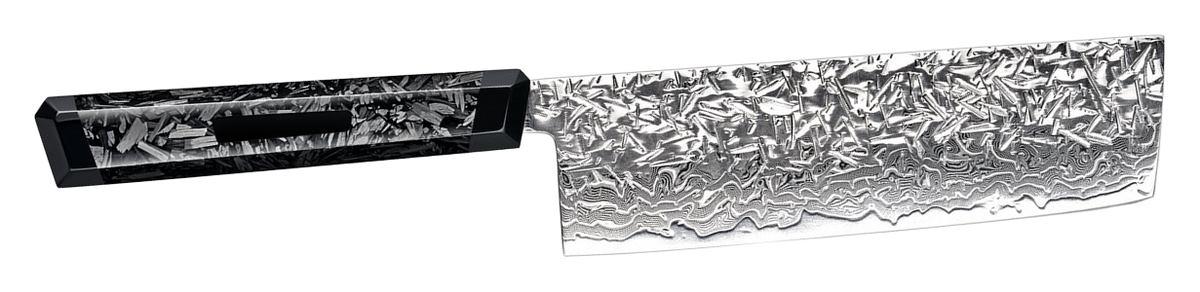
Damascus Nakiri Knives
Black Friday Month up to 30% off · Free tracked shipping · 30-day returns
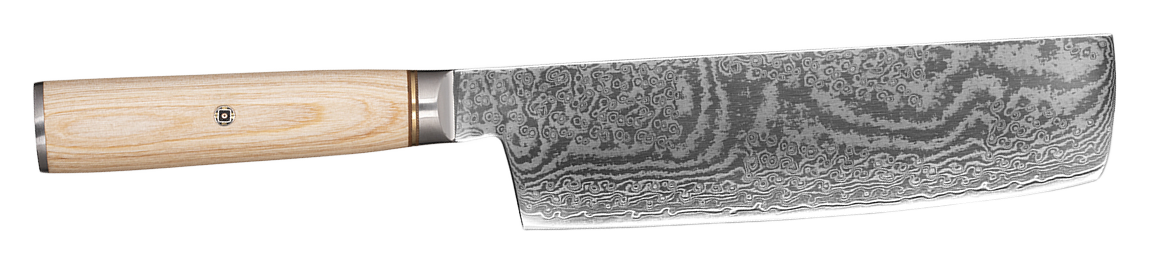
The damascus nakiri knife is the Japanese-style vegetable knife. Its straight, rectangular blade meets the cutting board along its full length, so every cut goes all the way through the vegetable in one stroke. Our 7-inch (18 cm) nakiri knives have a damascus steel blade with a 10Cr15CoMoV core, hardened to 60 HRC.

 -29 %
Dune · Damascus Nakiri Knife 7"

 -25 %
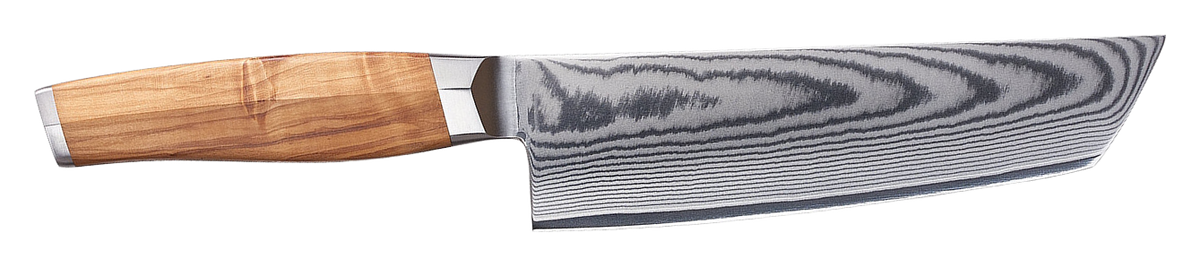
Olea · Damascus Nakiri Knife 7"

 -23 %
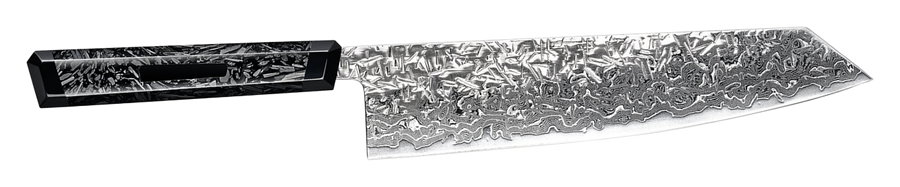
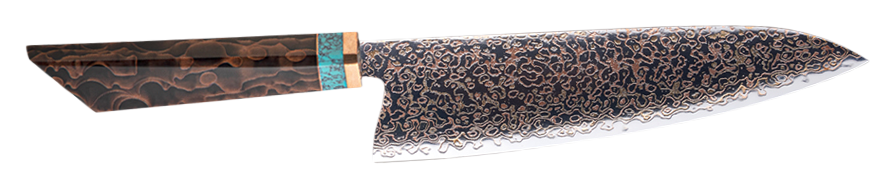
Obsidienne · Damascus Nakiri Knife 6.7"

 -23 %
Carmin · Damascus Nakiri Knife 7"

 -23 %
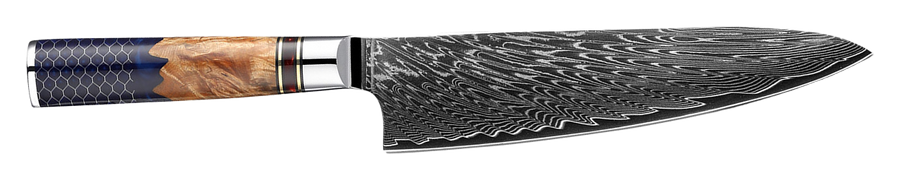
Cobalt · Damascus Nakiri Knife 7"

 -23 %
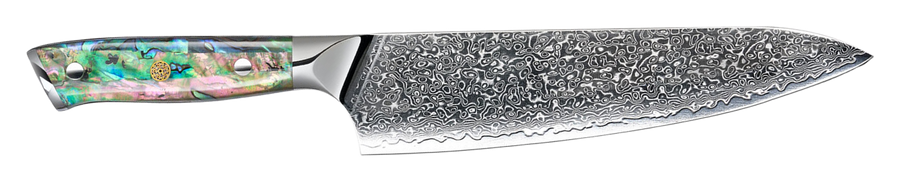
Iris · Damascus Nakiri Knife 6.5"

 -23 %
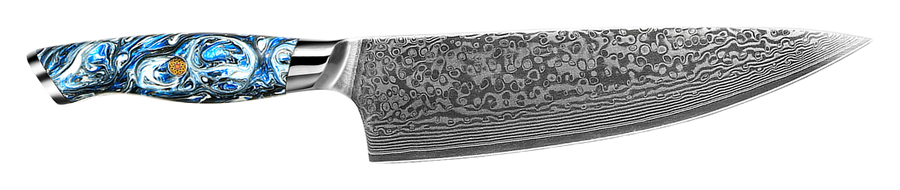
Marea · Damascus Nakiri Knife 7"

 -21 %
Azur · Damascus Nakiri Knife 7"

 -25 %
Magma · Damascus Nakiri Knife 7"
Buying guide
Why choose a nakiri knife?
A nakiri knife is made for cooks who prep a lot of vegetables. With a perfectly straight edge, no slices stay joined at the bottom the way they can with a curved blade. A nakiri is ideal for cabbage, leeks, carrots, squash and julienne.
Nakiri, cleaver or santoku?
A nakiri knife is thin and light, and reserved for vegetables. A cleaver is heavier and also handles meat and small soft bones: see our damascus meat knives. A santoku knife keeps a tip and moves easily from meat to vegetables.
Nakiri knife technique
A nakiri knife is used with a straight up-and-down motion or a forward push, with the flat of the blade against the knuckles of the hand holding the vegetable. Never rock the blade, and never use a nakiri to break a bone or cut frozen food.
Model comparison
| Model | Blade | Damascus steel | Handle | Weight |
|---|---|---|---|---|
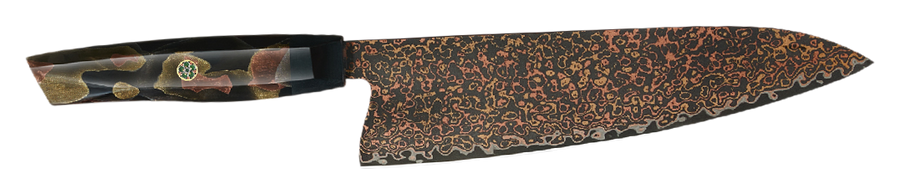
| Magma · Damascus Nakiri Knife 7" | 7" (18 cm) | 37 layers | Black G10, resin and copper mesh, decorative mosaic pin | 6.1 oz (174 g) |
| Azur · Damascus Nakiri Knife 7" | 7" (18 cm) | 37 layers | Brown marbled resin, turquoise and white brass collar | 6.5 oz (183 g) |
| Marea · Damascus Nakiri Knife 7" | 7" (18 cm) | 67 layers | Burl wood and blue resin, stainless steel bolster | - |
| Iris · Damascus Nakiri Knife 6.5" | 6.5" (16 cm) | 67 layers | Abalone shell in resin, steel bolster, rivets and decorative mosaic pin | 8.4 oz (237 g) |
| Cobalt · Damascus Nakiri Knife 7" | 7" (18 cm) | 67 layers | Burl wood and honeycomb midnight blue resin, stainless steel bolster | 8.0 oz (228 g) |
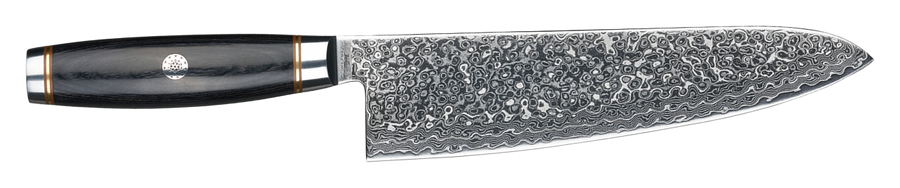
| Carmin · Damascus Nakiri Knife 7" | 7" (18 cm) | 67 layers | Burl wood and red resin, stainless steel bolster | 8.0 oz (228 g) |
| Obsidienne · Damascus Nakiri Knife 6.7" | 6.7" (17 cm) | 129 layers | Black resin and carbon fiber, octagonal Japanese-style shape | - |
| Olea · Damascus Nakiri Knife 7" | 7" (18 cm) | 67 layers | Olive wood, stainless steel bolster and end cap | 7.9 oz (223 g) |
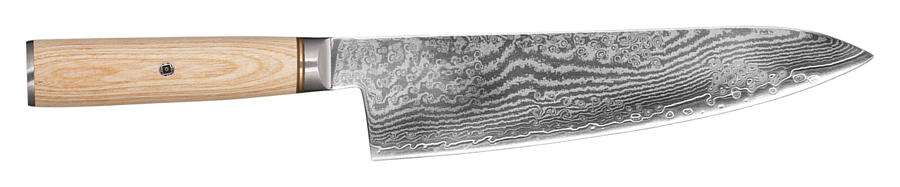
| Dune · Damascus Nakiri Knife 7" | 7" (18 cm) | 67 layers | Light pakkawood (resin-impregnated laminated wood), steel bolster and end cap, decorative mosaic pin | 7.7 oz (218 g) |
Questions
Before you buy
What does nakiri mean?
Nakiri comes from the Japanese nakiri bōchō, meaning "knife for cutting vegetables."
Can a nakiri knife cut meat?
A nakiri knife can slice boneless meat, but without a tip it is less practical than a chef knife for meat and fish.
Do I need a nakiri knife if I already have a chef knife?
A nakiri knife is not essential, but if you cook a lot of vegetables, its straight blade makes your cuts faster and cleaner.
Do I need to oil my Damascus knife?
You only need to oil a Damascus knife regularly if the blade is carbon steel or the handle is unfinished wood. A thin coat of food-safe mineral oil or camellia oil protects against moisture. Stainless Damascus needs oil only now and then, for storage. Avoid WD-40 and cooking oils that turn sticky on a kitchen knife.
Can Damascus knives go in the dishwasher?
No, Damascus knives should never go in the dishwasher. Heat, long exposure to moisture and harsh detergents dull the pattern, encourage rust and damage the handle. The blade also knocks against dishes and loses its edge. Hand-washing with warm soapy water and drying immediately takes under a minute and keeps the knife in shape.
Can you sharpen a Damascus knife?
Yes, you can sharpen a Damascus knife like any kitchen knife, ideally on a whetstone. A medium grit around 1000 rebuilds the edge and a finer stone polishes it. Japanese-style blades are usually sharpened at a lower angle than Western knives. Skip pull-through sharpeners, which are too harsh for hard steel, and use a ceramic honing rod between sessions.
Which Japanese-style knife should I buy first?
The best first Japanese-style knife is a chef knife (gyuto) or a santoku. Both slice, dice and chop meat, fish and vegetables, so one blade covers most daily cooking. Pick a gyuto if you like a longer blade and rocking cuts, a santoku if you prefer a shorter, lighter knife. Add a nakiri later if you cook a lot of vegetables.