








Damascus Bread and Carving Knives
Black Friday Month up to 30% off · Free tracked shipping · 30-day returns
A Damascus bread knife has a serrated 7.5 to 8-inch blade that bites through crust without crushing the crumb. The carving knife is longer (10 inches) with a straight edge, for slicing roasts, ham or salmon thin. Five bread knives and three carving knives, from $89 to $159, in 7 series.

 -26 %
Eclipse · Damascus Bread Knife 8"

 -26 %
Eclipse · Damascus Slicing Knife 8"

 -26 %
Dune · Damascus Bread Knife 9"

 -26 %
Dune · Damascus Slicing Knife 9.5"

 -23 %
Olea · Damascus Slicing Knife 9"

 -23 %
Cosmos · Damascus Bread Knife 8"

 -25 %
Carmin · Damascus Bread Knife 7.5"

 -25 %
Cobalt · Damascus Bread Knife 7.5"

 -23 %
Iris · Damascus Bread Knife 8"

 -23 %
Iris · Damascus Slicing Knife 10"

 -25 %
Marea · Damascus Bread Knife 8"

 -28 %
Azur · Damascus Slicing Knife 10"

 -23 %
Magma · Damascus Slicing Knife 10"
Buying guide
Bread knife or carving knife?
Both cut long slices, but not the same foods. A bread knife has a serrated edge: the serrations grip the crust like a fine saw, then glide through the crumb without squashing it. It also works on tomatoes, citrus and cakes. A carving (slicing) knife has a long, narrow, straight blade: it cuts cooked meat and raw fish in a single stroke without tearing the fibers.
Which length?
For bread, 7.5 to 8 inches handles baguettes, sourdough and brioche. Go for 8 inches (Cosmos, Iris) if you often buy large loaves. For carving, a 10-inch blade lets you slice a roast, a turkey breast or a ham in one motion: that is the length of our Magma, Azur and Iris carving knives.
Steel and care
Every blade is Damascus steel (37 or 67 layers depending on the series) around a 10Cr15CoMoV stainless core with a stated hardness of 60 ± 2 HRC. Hand wash and dry right away. A bread knife rarely needs sharpening; a carving knife is touched up on a honing rod or a whetstone. Read more in our bread knife guide.
Model comparison
| Model | Blade | Damascus steel | Handle | Weight |
|---|---|---|---|---|
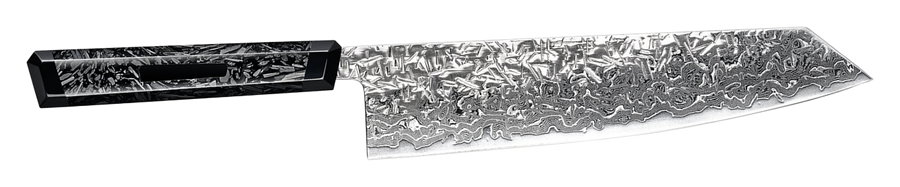
| Magma · Damascus Slicing Knife 10" | 10" (25 cm) | 37 layers | Black G10, resin and copper mesh, decorative mosaic pin | 6.0 oz (171 g) |
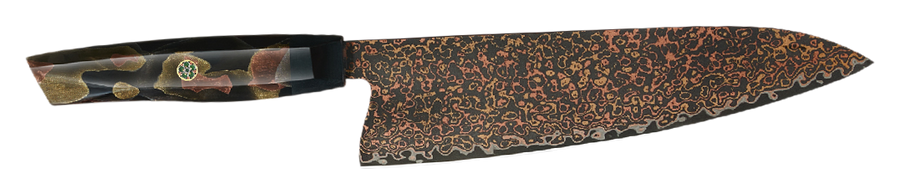
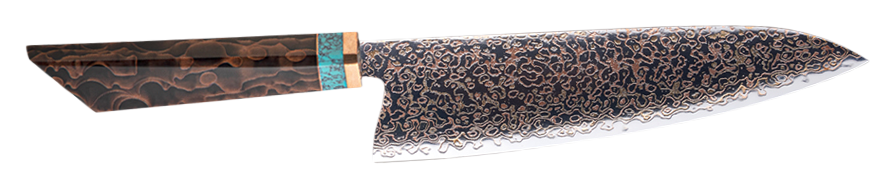
| Azur · Damascus Slicing Knife 10" | 10" (26 cm) | 37 layers | Brown marbled resin, turquoise and white brass collar | 6.3 oz (180 g) |
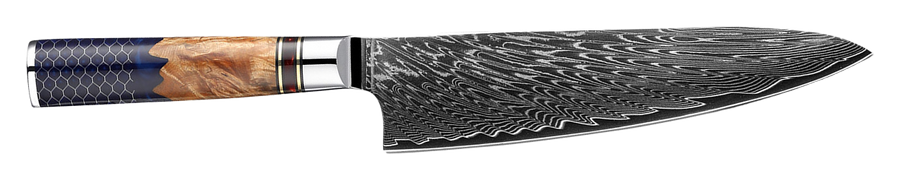
| Marea · Damascus Bread Knife 8" | 8" (20 cm) | 67 layers | Burl wood and blue resin, stainless steel bolster | - |
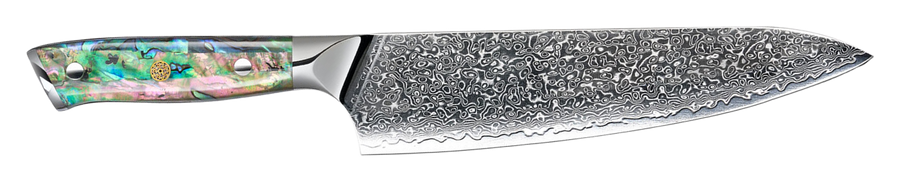
| Iris · Damascus Slicing Knife 10" | 10" (26 cm) | 67 layers | Abalone shell in resin, steel bolster, rivets and decorative mosaic pin | 7.8 oz (222 g) |
| Iris · Damascus Bread Knife 8" | 8" (21 cm) | 67 layers | Abalone shell in resin, steel bolster, rivets and decorative mosaic pin | 7.4 oz (209 g) |
| Cobalt · Damascus Bread Knife 7.5" | 7.5" (19 cm) | 67 layers | Burl wood and honeycomb midnight blue resin, stainless steel bolster | 6.2 oz (177 g) |
| Carmin · Damascus Bread Knife 7.5" | 7.5" (19 cm) | 67 layers | Burl wood and red resin, stainless steel bolster | 6.2 oz (177 g) |
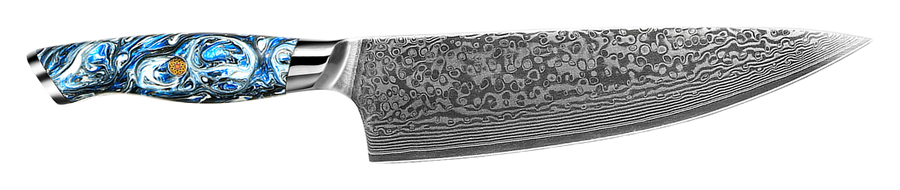
| Cosmos · Damascus Bread Knife 8" | 8" (21 cm) | 67 layers | Blue marbled epoxy resin, steel bolster and end cap, decorative mosaic pin | 8.0 oz (226 g) |
| Olea · Damascus Slicing Knife 9" | 9" (23 cm) | 67 layers | Olive wood, stainless steel bolster and end cap | 7.8 oz (221 g) |
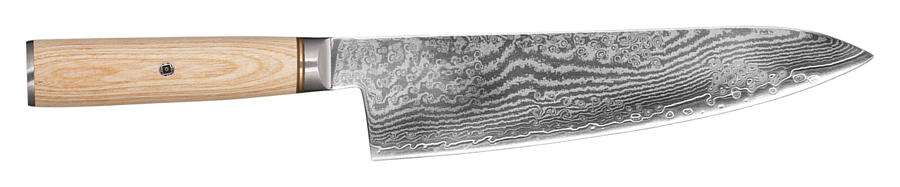
| Dune · Damascus Slicing Knife 9.5" | 9.5" (24 cm) | 67 layers | Light pakkawood (resin-impregnated laminated wood), steel bolster and end cap, decorative mosaic pin | 6.5 oz (184 g) |
| Dune · Damascus Bread Knife 9" | 9" (22 cm) | 67 layers | Light pakkawood (resin-impregnated laminated wood), steel bolster and end cap, decorative mosaic pin | 6.3 oz (178 g) |
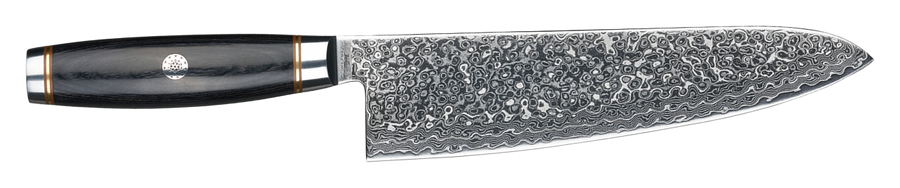
| Eclipse · Damascus Slicing Knife 8" | 8" (20 cm) | 67 layers | Black pakkawood, copper-tone rings, steel bolster and end cap, decorative mosaic pin | 7.1 oz (202 g) |
| Eclipse · Damascus Bread Knife 8" | 8" (20 cm) | 67 layers | Black pakkawood, copper-tone rings, steel bolster and end cap, decorative mosaic pin | 7.0 oz (199 g) |
Questions
Before you buy
What is the best bread knife?
A good bread knife has a serrated blade of at least 7.5 inches, stiff enough not to flex in hard crust, and a handle that leaves room for your knuckles above the board. Our Damascus bread knives are 7.5 to 8 inches, with a 10Cr15CoMoV core and a stated hardness of 60 ± 2 HRC.
Can a bread knife cut other foods?
Yes: the serrated edge cuts tomatoes, citrus, pineapple and cakes without crushing them. It is not made for raw meat or chopping.
How long should a carving knife be?
10 to 12 inches: the longer the blade, the more you can slice in one pass, for clean slices that keep their juices. Our carving knives are 10 inches.
Can I return the knife?
Yes. You have 30 days from delivery to return it for free, unused and in its box. Tracked shipping is free.
Do I need to oil my Damascus knife?
You only need to oil a Damascus knife regularly if the blade is carbon steel or the handle is unfinished wood. A thin coat of food-safe mineral oil or camellia oil protects against moisture. Stainless Damascus needs oil only now and then, for storage. Avoid WD-40 and cooking oils that turn sticky on a kitchen knife.
Can Damascus knives go in the dishwasher?
No, Damascus knives should never go in the dishwasher. Heat, long exposure to moisture and harsh detergents dull the pattern, encourage rust and damage the handle. The blade also knocks against dishes and loses its edge. Hand-washing with warm soapy water and drying immediately takes under a minute and keeps the knife in shape.
Can you sharpen a Damascus knife?
Yes, you can sharpen a Damascus knife like any kitchen knife, ideally on a whetstone. A medium grit around 1000 rebuilds the edge and a finer stone polishes it. Japanese-style blades are usually sharpened at a lower angle than Western knives. Skip pull-through sharpeners, which are too harsh for hard steel, and use a ceramic honing rod between sessions.
Which Japanese-style knife should I buy first?
The best first Japanese-style knife is a chef knife (gyuto) or a santoku. Both slice, dice and chop meat, fish and vegetables, so one blade covers most daily cooking. Pick a gyuto if you like a longer blade and rocking cuts, a santoku if you prefer a shorter, lighter knife. Add a nakiri later if you cook a lot of vegetables.