


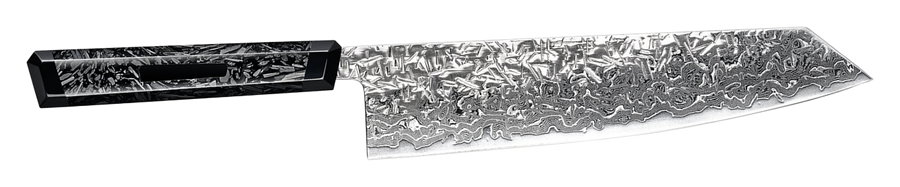
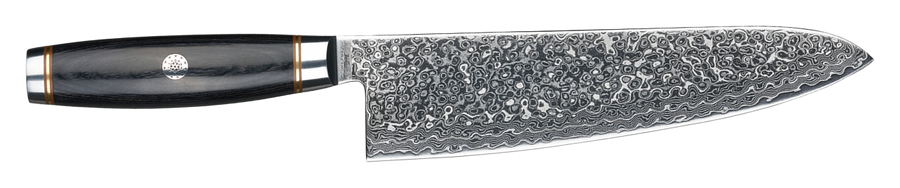
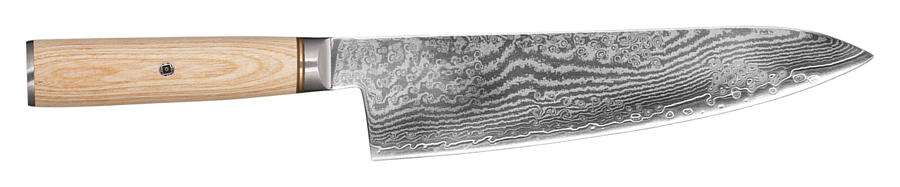
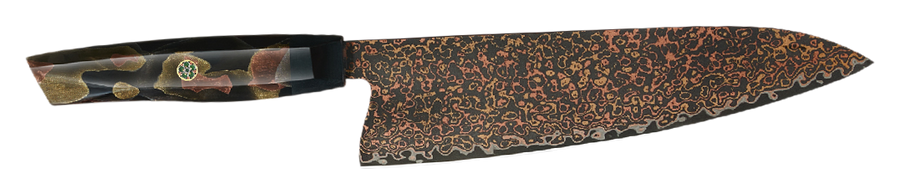




The short answer
- A bread knife has a serrated edge: the teeth saw through the crust, then glide through the crumb without squashing it. A straight edge, even a sharp one, crushes fresh bread.
- Length: 7.5 to 8 in (19 to 21 cm) handles sandwich loaves, baguettes, bagels, brioche and challah; 9 to 10 in and up is more comfortable on a wide sourdough boule.
- The same knife slices tomatoes, citrus, cakes and stacked sandwiches. It is not for bones or frozen food.
- You rarely sharpen a bread knife, and never like a straight edge: one scallop at a time with a tapered rod, then remove the burr on the flat side.
- According to the Damascus Knife Price Survey (October 2026, 36 Damascus bread knives in the US), the median price is $104.99, and 81% of listings cost $89 or more.
To slice bread without crushing it, you need a serrated knife long enough to saw across the loaf in long strokes: 7.5 to 8 inches covers sandwich bread, baguettes and brioche, while a wide sourdough boule is easier with 9 inches or more. A bread knife is cared for differently from a straight-edged knife: wash it by hand, sharpen it rarely, and do it one serration at a time.
Why does a bread knife have a serrated edge?
A bread knife has a serrated edge because bread combines a hard crust with a soft crumb. The serrations work like a fine saw: their points catch the crust instead of skidding over it, then the blade moves back and forth through the crumb with no downward pressure. A straight edge has to push down, and that pressure is what flattens a fresh loaf.
The design has a long history. A German maker showed a bread knife at the 1893 World's Columbian Exposition in Chicago, and Joseph E. Burns of Syracuse, New York, filed a US patent in 1919 for a knife with angled grooves forming small cutting edges, granted in 1921 as patent 1,388,547.
You will find two main serration styles. Pointed teeth bite hard into a thick crust. Rounded, scalloped or wavy serrations cut more gently and leave fewer crumbs on sandwich bread, brioche or cake. In its bread knife testing, America's Test Kitchen found that tall, pointed serrations grip food better than short or scalloped ones, and that blades with fewer serrations cut better: the top performers had 29 to 34, while blades with more than four per inch struggled.
At Damascus Knife, all five bread knives are listed with a serrated (saw-tooth) edge on their product pages, around a 10Cr15CoMoV core with a manufacturer-stated hardness of 60 ± 2 HRC and 67 stated Damascus layers.
What length bread knife should you buy?
The right bread knife length depends on the width of the loaves you slice most: the blade should run a few inches past the loaf so you can saw in long strokes. A 7.5 to 8 inch blade covers sandwich loaves, baguettes, bagels, brioche and challah; 9 to 10 inches and up is more comfortable on a large round sourdough or a wide country loaf.
Bread knives on the market run from about 6 to 14 inches. In the Damascus Knife Price Survey, 33 of the 36 US Damascus bread knives list a blade length, and the median is 8 inches. 23 of those 33 measure about 8 inches (19.5 to 22.5 cm), 8 measure 9 to 10 inches, and only 2 fall outside that range. In other words, 8 inches is the standard size for a Damascus bread knife in the US.
| What you slice most | Suggested blade length | Serration style |
|---|---|---|
| Sandwich loaf, baguette, bagels | 7.5 to 8 in | Pointed or wavy |
| Brioche, challah, banana bread, cake | 7.5 to 8 in | Wavy, for fewer crumbs |
| Average sourdough or country loaf | 8 to 9 in | Pointed |
| Large boule, loaf over 2 lb | 9 to 10 in and up | Pointed |
| Tomatoes, citrus | Any length | Pointed |
Longer is not always better. A long blade is awkward on a small board, when you halve a bagel or cut a sandwich in two. If your household mostly buys sandwich bread, bagels and baguettes, 7.5 to 8 inches is the most practical size.

The table lists the specs published on our product pages. Cobalt and Carmin share the same 7.5 inch blade; Cosmos has the thinnest spine at 0.07 in (1.8 mm).
| Series | Blade | Overall length | Spine | Weight | Price |
|---|---|---|---|---|---|
| Cobalt (wood and midnight blue resin) | 7.5 in (19 cm) | 12.7 in | 0.08 in | 6.2 oz (177 g) | $89 |
| Carmin (wood and red resin) | 7.5 in (19 cm) | 12.7 in | 0.08 in | 6.2 oz (177 g) | $89 |
| Marea (wood and blue resin) | 8 in (20 cm) | not listed | not listed | not listed | $89 |
| Cosmos (galaxy resin) | 8 in (21 cm) | 13.7 in | 0.07 in | 8.0 oz (226 g) | $99 |
| Iris (abalone under resin) | 8 in (21 cm) | 13.3 in | 0.08 in | 7.4 oz (209 g) | $129 |
Damascus Knife catalog · product pages, November 2026
The bread knives in the Damascus Knife catalog have 7.5 to 8 inch blades and weigh from 6.2 oz (Cobalt, Carmin) to 8.0 oz (Cosmos), a 1.7 oz (49 g) spread. The handle drives the weight: solid resin (Cosmos) and abalone under resin (Iris) weigh more than wood and resin (Cobalt, Carmin).
What is a bread knife used for besides bread?
A bread knife cuts anything with a firm or slippery outside and a soft inside: crusty bread, sandwich loaves, brioche, tomatoes, citrus, cakes and stacked sandwiches. It is a poor choice for finely dicing vegetables or mincing herbs, and it should never touch bones or frozen food.
| Food | Bread knife? | Why |
|---|---|---|
| Crusty bread, sourdough, baguette | Yes, its main job | The teeth catch the crust without compressing the crumb |
| Sandwich bread, brioche, challah | Yes | No downward pressure, so the crumb stays airy |
| Bagels, burger buns | Yes | Clean cut through the middle without flattening |
| Tomatoes, bell peppers | Yes | The teeth pierce the skin without crushing the flesh |
| Citrus, pineapple, melon | Yes | Thick or slippery rind, juicy inside |
| Layer cakes, sponge cake | Yes | Even horizontal cut when splitting a cake layer |
| Diced onion, herbs | No, use a straight edge | The teeth tear the fibers instead of cutting cleanly |
| Bones, frozen food | Never | The teeth of a thin, hard blade can chip |
Let fresh sandwich bread or brioche cool before slicing: warm crumb sticks to any blade. For a tomato, lay it on its side and let the teeth break the skin as you draw the knife toward you, without pressing.
For vegetables and everyday prep, a straight-edged knife is still the right tool. Our guide santoku vs chef knife (and nakiri) explains which one.
How do you slice bread without squashing it?
Slicing bread without squashing it comes down to three habits: use the full length of the blade, let the serrations do the work in a back-and-forth motion without pressing, and start at the top crust. Downward pressure is what crushes the crumb, not the knife itself; a good bread knife almost sinks in on its own.
- Set the loaf flat on a wood or plastic board. Cut a baguette on the bias for wider slices.
- Start at the top crust with long strokes from heel to tip. Short, fast strokes make more crumbs.
- Keep the blade vertical, or your slices end up wedge-shaped. A sandwich loaf is easier to slice lying on its side.
- If a boule is wider than your blade, cut it in half first, then slice each half from the cut face.
- Finish the cut without scraping the board: glass, marble and ceramic boards dull the tips of the teeth fast.
How do you care for and sharpen a bread knife?
A bread knife is not maintained like a straight-edged knife. You wash it by hand and dry it right away, like any Damascus knife, but you rarely sharpen it: the tips of the serrations do most of the work and stay effective for a long time. When it slows down, you touch up the serrations one by one with a tapered rod, never on a flat whetstone.
A flat whetstone or honing steel run along the whole edge only reaches the tips of the teeth: over time it rounds them off and wipes out the serration. Sharpener maker Work Sharp describes the basic method: a round hone passed through each serration, then the burr stripped off the flat side. In practice:
- Find the beveled side: on most bread knives, each serration is ground on one side only and the other face is flat.
- Slide a round rod, ideally tapered (ceramic or steel), through each scallop at the angle of the existing bevel, moving along the taper until it fills the gullet.
- Give every scallop the same number of strokes so the serration stays even.
- Feel for the small burr on the flat side and remove it with two or three flat passes.
If that sounds like a lot of work, a professional sharpening service handles serrated knives. Everything else follows the rules for all our blades: no dishwasher, no soaking in the sink (especially wood and resin handles), dry immediately, and store separately in a block, on a magnetic strip or with a blade guard. Our guide how to care for and sharpen a Damascus knife covers it in detail.
A honing rod is the maintenance tool for straight edges like a chef's knife, santoku or paring knife. Running it along the full length of a bread knife does nothing useful.
How much does a Damascus bread knife cost?
A Damascus bread knife usually costs between $90 and $140 in the US. According to the Damascus Knife Price Survey (October 2026), the median price of Damascus bread knives sold individually is $104.99 across 36 listings; the middle half of listings sits between $89.99 and $139.95.
Damascus Knife Price Survey · October 2026
Survey of displayed prices on 10/21/2026 for Damascus kitchen knives sold individually at 15 US direct-to-consumer stores (529 listings). Bread knives: 36 listings from 10 stores, median $104.99, first quartile $89.99, third quartile $139.95. 29 of 36 listings (81%) cost $89 or more, and 21 of 36 (58%) cost $99 or more.
At Damascus Knife, three of our five bread knives are $89 (Marea, Cobalt, Carmin), Cosmos is $99, and Iris with its abalone handle is $129. All five have the same 10Cr15CoMoV stainless core, easy to maintain and sharpen, with a composition close to VG10. Our guide how much a good Damascus knife costs explains price gaps between steels, and Damascus steel and layers covers what layer counts mean.
A bread knife also makes a gift that gets used every day, from holiday baking to weekend sandwiches. For Christmas delivery in the US, order by Tuesday, December 1; gift ideas by recipient are in our guide giving a knife as a gift. Our five bread knives and three carving knives are all on one page: Damascus bread and carving knives.
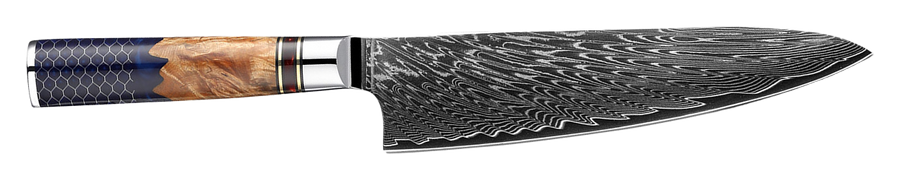
 Marea · Damascus Bread Knife 8"$89
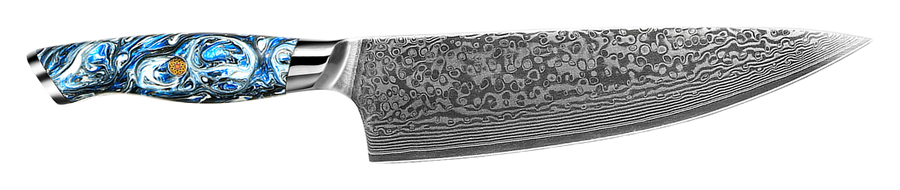
 Cosmos · Damascus Bread Knife 8"$99
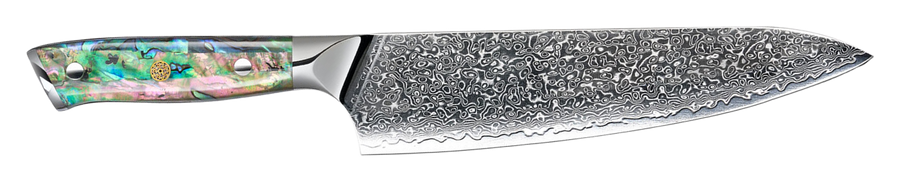
 Iris · Damascus Bread Knife 8"$129
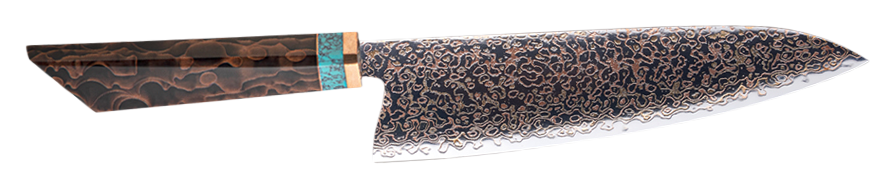
 Cobalt · Damascus Bread Knife 7.5"$89
Frequently asked questions
What is a bread knife used for?
A bread knife slices crusty bread, sandwich loaves, bagels, brioche and challah without crushing the crumb. Its serrated edge also handles tomatoes, citrus, pineapple, melon, layer cakes and stacked sandwiches. It is not a good tool for finely dicing vegetables or mincing herbs, and it should never be used on bones or frozen food.
What size bread knife is best?
For most home kitchens, a 7.5 to 8 inch blade is the most practical: it handles sandwich bread, baguettes, bagels, brioche and average loaves. If you bake or buy large sourdough boules often, a 9 to 10 inch blade is more comfortable. The blade should run a few inches past the loaf so you can saw in long strokes.
How do you sharpen a serrated bread knife?
Sharpen a bread knife rarely, one serration at a time. Slide a round, ideally tapered rod through each scallop on the beveled side at the original angle, with the same number of strokes each time, then remove the burr with a few flat passes on the flat side. A flat whetstone or pull-through sharpener rounds off the teeth. A professional sharpening service is a good alternative.
Is a serrated knife the same as a bread knife?
A bread knife is one kind of serrated knife: a long blade, usually 7.5 to 10 inches, built to saw through loaves. Other serrated knives are shorter, such as a 5 inch serrated utility knife or a tomato knife, and are meant for sandwiches, tomatoes and small fruit. For a whole loaf, the longer blade of a bread knife is easier to use.
Can you put a bread knife in the dishwasher?
No, a Damascus bread knife should not go in the dishwasher. Heat, harsh detergent and knocks against other dishes damage the tips of the serrations and wood or resin handles. Wash it by hand in warm soapy water, do not leave it soaking in the sink, and dry it right away with a towel.
Sources
Updated November 4, 2026 · Method: specs taken from Damascus Knife catalog product pages (length, spine thickness, weight); prices and lengths from the Damascus Knife Price Survey of 10/21/2026, 36 bread knives out of 529 US listings.