






The short answer
- On a modern Damascus kitchen knife, the pattern comes from forge-welded steel layers wrapped around a core. The core steel forms the edge and does the cutting.
- Layer count (37, 67, 100+) changes the pattern, not edge retention. Compare the core steel and its HRC hardness first.
- Rough tiers: 10Cr15CoMoV and 9Cr18MoV are standard stainless, VG10 and AUS10 mid-range, SG2/R2 high end. In US stores, the median goes from $85.99 (standard stainless) to $144.99 (VG10/AUS10) to $479.99 (premium).
- All 56 Damascus Knife blades have a 10Cr15CoMoV core rated 60 ± 2 HRC by the manufacturer: stainless, easy to sharpen, close to VG10 in composition, from $99.
On a Damascus knife, the core steel and its heat treatment decide how it cuts: the Damascus itself is a cladding of forge-welded layers around that core, which protects and decorates the blade. A 67-layer blade does not cut better than a 37-layer one: to judge the cut, look at the core steel and its hardness, not the pattern.
Core or layers: what actually cuts on a Damascus knife?
The cutting edge of a Damascus kitchen knife is formed by the core steel, a hard steel sandwiched between layers of different steels that are forge-welded together. The outer layers create the pattern and protect the core; they do no work at the edge. The core steel sets edge retention, ease of sharpening and hardness.
Takefu Special Steel, the mill that developed VG10, describes the logic: three-layer steel is the construction most used for kitchen knives because it pairs an expensive edge steel with a cheaper base metal around it. Multi-layer steel, in Takefu's own words, is used mainly as pattern material for knives.
The word "Damascus" is confusing. Historical Damascus (wootz) steel got its pattern from the way the metal crystallized. Today's Damascus is pattern-welded steel: different steels are stacked, forge-welded, then acid-etched so the layers show, because the acid darkens each steel differently.
Common core steels and what is in them
Damascus core steels share one trait: about 1% carbon and 13 to 19% chromium, which makes them stainless and lets them reach roughly 58 to 64 HRC. What separates them is the alloying (molybdenum, vanadium, cobalt) and how the steel is made, conventionally melted or by powder metallurgy.
The numbers below come from Takefu's own data for VG10, Carpenter's datasheet for 440C and the zknives steel database for the other grades. Takefu does not publish the SG2 composition (its datasheet says "not disclosed"): the figures are from zknives and match the analysis published by metallurgist Larrin Thomas (Knife Steel Nerds).
| Steel | Carbon | Chromium | Other elements | Typical hardness | Edge retention | Sharpening | Stain resistance | Tier (Price Survey, US) |
|---|---|---|---|---|---|---|---|---|
| 9Cr18MoV | 0.85 to 0.95% | 17 to 19% | Mo 1 to 1.3%, V 0.07 to 0.12% | 58 to 60 HRC | Fair | Easy | Very good | Standard stainless: median $85.99 |
| 440C | 0.95 to 1.20% | 16 to 18% | Mo 0.75% max | Up to about 60 HRC | Fair to good | Easy to moderate | Good | Standard stainless: median $85.99 |
| 10Cr15CoMoV | 0.95 to 1.05% | 14.5 to 15.5% | Co 1.3 to 1.8%, Mo 0.8 to 1.2%, V 0.25 to 0.35% | 58 to 62 HRC | Fair to good, little testing | Easy | Good | Standard stainless: median $85.99 |
| AUS10 | 0.95 to 1.10% | 13 to 14.5% | Mo 0.1 to 0.3%, V 0.1 to 0.25%, Ni 0.49% | 58 to 60 HRC | Good | Easy | Good | Mid: median $144.99 |
| VG10 | 1.00% | 15.00% | Co 1.55%, Mo 1.00%, V 0.25% | 60 HRC and up | Good | Easy to moderate | Good | Mid: median $144.99 |
| SG2 / R2 (powder) | 1.25 to 1.45% | 14 to 16% | Mo 2.3 to 3.3%, V 1.8 to 2.2% | 62 HRC and up | High | Slower | Good | Premium: median $479.99 |
The edge retention, sharpening and stain columns are qualitative guides, not lab results. According to Knife Steel Nerds, edge retention is driven mostly by hardness and carbide volume: SG2, with more carbon, molybdenum and vanadium, wears more slowly. The same author measured VG10 slightly below 440C in CATRA edge testing, a useful reminder that a famous name is not a performance figure.
zknives could not find 10Cr15CoMoV in any official standard: its recipe follows VG10, and published ranges vary by source. The tier column shows the median of all listings in that tier in our survey, not the price of one steel.
Is 10Cr15CoMoV a good steel? The core of our 56 knives
10Cr15CoMoV is a stainless steel with about 1% carbon, 15% chromium and 1.5% cobalt, close to VG10 in composition. At Damascus Knife it is the core of all 56 knives, rated 60 ± 2 HRC by the manufacturer. It belongs to the standard stainless steels, the most common cores on Damascus kitchen knives.
Its strengths are real. It sharpens easily, resists staining thanks to its chromium, and keeps prices accessible: $99 for the Marea 8-inch chef knife, $50 under the $149 median of 8-inch (20 to 22 cm) Damascus chef knives in the survey (n = 80).
As with any steel, results also depend on heat treatment, so we stick to the hardness stated by the manufacturer rather than promise a given edge life. In a home kitchen, a few strokes on a honing rod before cooking and a whetstone now and then keep the edge sharp.
Stainless does not mean stain-proof: a knife left wet or run through the dishwasher can spot. The details are in our guide on Damascus knife care and sharpening.
HRC hardness: what does 60 ± 2 mean on a spec sheet?
HRC (Rockwell C) hardness measures how well hardened steel resists a diamond indenter. For kitchen knives, a higher number keeps a fine edge longer but makes it more brittle. Most Japanese-style Damascus knives sit between 58 and 64 HRC, harder than the typical Western kitchen knife.
For scale: zknives notes that 1.4116, the steel of mainstream German kitchen knives, is usually hardened to 54 to 56 HRC. Takefu rates VG10 at 60 HRC and up and SG2 at 62 HRC and up. In his own test, Knife Steel Nerds reached about 60.7 HRC for both steels with the same heat treatment.
"60 ± 2 HRC" on our product pages means a hardness of 58 to 62 HRC as stated by the manufacturer, not measured by us. At that level a blade does not like twisting or bones: you slice, you do not pry. High hardness also cannot make up for a steel that is low in carbides.
Does more layers mean a better Damascus knife?
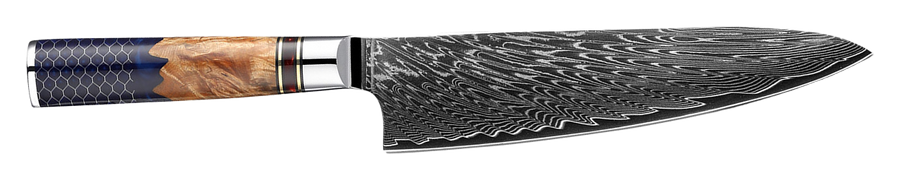
The layer count of a Damascus knife describes the cladding, not the edge. More layers give finer, tighter lines; fewer layers give wider, bolder bands. Cutting, sharpening and hardness stay those of the core steel, whether the blade lists 37, 67 or 110 layers.
The stated number usually counts the core plus the layers on each side: the most common way 67 layers is presented is 1 core + 33 + 33. At Damascus Knife, the Magma and Azur series are listed at 37 layers and the other five (Marea, Iris, Cobalt, Carmin, Cosmos) at 67 layers, as stated by the manufacturer.

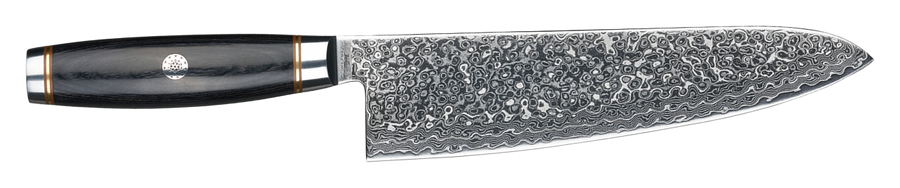
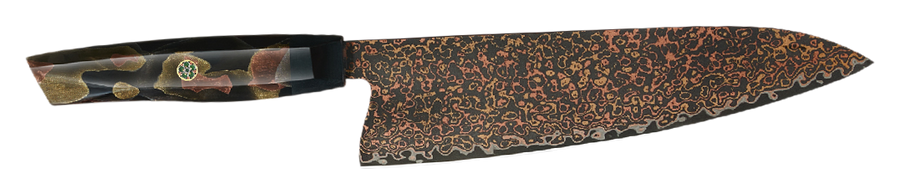
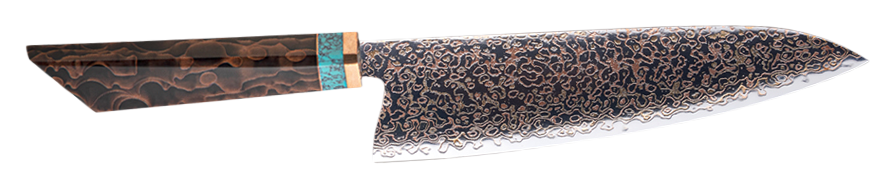
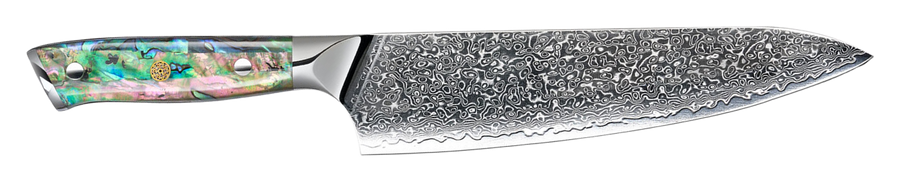
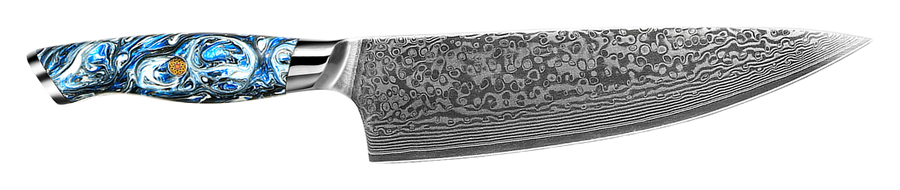
You can see the difference: the 37-layer Magma shows a coppery diamond pattern with wide links, the 67-layer Marea fine, tight waves. It is a style choice, like the handle.
Damascus Knife Price Survey · October 2026
According to the Damascus Knife Price Survey (October 2026, 529 single Damascus kitchen knife listings across 15 US direct-to-consumer stores), 415 listings state a layer count, and "67 layers" accounts for 50.8% of them (211). Only 0.5% list 37 layers (2 listings) and 7.0% list 100 layers or more (29). Within the same steel tier (VG10/AUS10), blades under 50 layers have a median price of $179 (n = 71) and blades with 50 to 79 layers $129 (n = 102): more layers does not mean a higher price.
On steel, the same survey shows a clear gap between tiers: a median of $85.99 for standard stainless steels (n = 70), $144.99 for VG10/AUS10 (n = 189, 69% more), and $479.99 for premium SG2/R2, powder steels, Aogami, Shirogami and Ginsan (n = 84, 5.6 times standard stainless). Listings that name 10Cr15CoMoV or 9Cr18MoV have a median of $85.99 (n = 71). The full price breakdown is in our article on what a good Damascus knife costs.
How can you tell a real Damascus knife from a fake one?
Real forge-welded Damascus has layers that run through the steel: the pattern shows on the spine, on the face and into the sharpened area, and it never repeats exactly. A laser-etched or printed pattern lives only on the surface of the flat sides, which is the most common sign of a fake Damascus knife.
Checks that apply to any knife:
- The spine: on welded Damascus you can see fine lengthwise lines. A perfectly plain spine under a busy pattern on the flats is a red flag.
- The edge bevel: on a cored blade, the pattern stops a few millimeters before the edge, where sharpening exposes the plain core. That border is usually slightly irregular; a dead-straight, crisp line points to etching.
- Repetition: a printed pattern repeats the same motif at regular intervals, often identical on both sides.
- Feel: the acid etch on Damascus leaves a very faint relief, while a print is perfectly smooth.
- The spec sheet: core steel, HRC hardness and layer count should be listed. If they are missing, be careful.
For our own blades, we stick to the manufacturer's specs: 10Cr15CoMoV core, 37 or 67 layers as stated, 60 ± 2 HRC.
Which core steel fits your kitchen?
The right core steel for a Damascus knife depends on how often you are willing to sharpen and what you want to spend. 10Cr15CoMoV or 9Cr18MoV suits a home kitchen well: stainless and easy to touch up; VG10 and AUS10 are the middle tier; SG2 is for cooks who want to sharpen as rarely as possible.
If you are new to whetstones, an easy-sharpening steel like 10Cr15CoMoV forgives mistakes. If you want an edge that lasts weeks of heavy prep, pay for SG2: in our survey, SG2/R2 listings have a median of $499.99 (n = 15). Between the two, the choice comes down to shape (see santoku vs chef knife) and pattern. Ordering for the holidays? Order by Tuesday, December 1.
To compare the patterns for yourself, look at the Magma series, 37 copper layers and the Marea series, 67 layers and blue resin, or all our Damascus chef knives.
To check that a blade is real layered Damascus and not just an etched pattern, see our guide real vs fake Damascus steel.
 Magma · Damascus Chef Knife 8"$149
 Marea · Damascus Chef Knife 8"$99
 Iris · Damascus Chef Knife 8"$129
Frequently asked questions
Are Damascus knives good quality?
A Damascus knife is as good as its core steel and heat treatment. The layered pattern is cladding; the core forms the edge. A VG10 or SG2 core at 60 to 64 HRC makes a very capable kitchen knife, while a standard stainless core such as 10Cr15CoMoV or 9Cr18MoV cuts well and is easy to sharpen. Judge the steel and hardness, not the pattern.
Is 10Cr15CoMoV a good steel?
10Cr15CoMoV is a stainless kitchen knife steel: about 1% carbon, 15% chromium and 1.5% cobalt, close to VG10 in composition and usually hardened to 58 to 62 HRC. It sharpens easily and resists staining. All 56 Damascus Knife knives use this core, rated 60 ± 2 HRC by the manufacturer.
Is VG10 better than 10Cr15CoMoV?
On paper the two are nearly identical: about 1% carbon, 15% chromium, 1% molybdenum and cobalt. VG10 is a branded steel from Takefu Special Steel with published data (60 HRC and up); 10Cr15CoMoV has no official standard, and results depend on the mill and heat treatment. In the Damascus Knife Price Survey, VG10/AUS10 knives sell at a $144.99 median vs $85.99 for standard stainless steels.
How can you tell a real Damascus knife?
Check the spine: on forge-welded Damascus, fine layer lines show there because the layers run through the steel. A laser-etched or printed pattern sits only on the flats, often repeats at regular intervals and ends in a dead-straight line before the edge. A trustworthy listing also states the core steel, HRC hardness and layer count.
Does more layers make a Damascus knife better?
No. Layers change the look, not the cutting. More layers give finer lines, fewer give bolder bands, and the core steel does the cutting either way. In the Damascus Knife Price Survey (October 2026), 50.8% of US listings that give a layer count say 67 layers, and within the same steel tier, blades under 50 layers were actually priced higher.
What is better, Damascus steel or stainless steel?
It is not either-or: most modern Damascus kitchen knives have a stainless core, such as VG10 or 10Cr15CoMoV, wrapped in patterned layers. A Damascus knife with a VG10 core cuts like a plain VG10 knife with the same heat treatment. You pay extra for the look, so choose by core steel and hardness first.
Sources
Updated October 27, 2026 · Method: compositions checked against steelmaker data (Takefu, Carpenter) and the zknives database; market figures from the Damascus Knife Price Survey of October 21, 2026 (529 listings, 15 US direct-to-consumer stores, listed prices in $); layer count and hardness of our blades as stated by the manufacturer.