






The short answer
- Real Damascus on a modern kitchen knife is pattern-welded steel: several steels forge-welded, folded, then acid-etched to reveal the layers. The pattern runs through the metal.
- Fake Damascus is a single-steel blade with a pattern laser-etched, chemically stenciled or printed on top. It lives on the surface and disappears when the blade is ground or sharpened.
- The most reliable checks: the spine, the heel, the bright band along the edge, repeating patterns, and the spec sheet (core steel, layer count, HRC hardness).
- In the Damascus Knife Price Survey (October 2026, 529 listings from 15 US stores), 54.1% of listings state both the core steel and the layer count.
- The 54 Damascus blades at Damascus Knife are layered blades, 37 or 67 layers as stated by the manufacturer, around a 10Cr15CoMoV core.
You can tell real Damascus steel by a pattern that runs through the blade: the layers show on the spine, at the heel and right down to the band along the edge, and they never repeat exactly. A fake Damascus knife carries a laser-etched or printed design on a single steel, visible only on the flat faces, and it wears away when the blade is sharpened or sanded.
What is real Damascus steel?
Real Damascus steel on a kitchen knife today means pattern-welded steel: steels of different composition are stacked, forge-welded, drawn out and folded, and the finished blade is etched in acid. Because the steels react differently to the acid, the layers show up as light and dark lines across the blade.
The word Damascus actually covers two materials. Historical Damascus steel, or wootz, is a high-carbon crucible steel whose pattern comes from bands of carbides inside a single metal, with no welding at all. Metallurgist John Verhoeven and bladesmith Alfred Pendray showed in the journal JOM in 1998 that trace impurities such as vanadium drive those bands, and noted that the art of making these blades was lost long ago.
Wikipedia notes that pattern-welded steel has been sold as "Damascus" in the knife world since 1973, when bladesmith William F. Moran unveiled his Damascus knives, and Knife Steel Nerds, the site of metallurgist Larrin Thomas, traces the mix-up back to at least 1824. So when people say "real Damascus" for a kitchen knife today, they mean pattern-welded steel, not wootz.
| Type | How it is made | Where the pattern comes from | Does the pattern go through the steel? |
|---|---|---|---|
| Historical Damascus (wootz) | High-carbon crucible steel, one metal | Carbide bands revealed by etching | Yes |
| Pattern-welded Damascus | Several steels forge-welded and folded | Layers of different steels revealed by etching | Yes |
| Imitation ("Damascus pattern") | One steel, pattern added afterward | Laser etching, stenciled acid etch or printing | No, surface only |
What does fake Damascus look like?
Fake Damascus is a blade cut from one piece of steel, often a basic stainless, with a wavy design added to mimic layers. The design is laser-etched, acid-etched through a stencil or printed. Cut the blade in half and there are no layers inside: the pattern exists only on the faces you can see.
Laser marking gives these blades an industrial precision, which is why some patterns look suspiciously even. A stenciled acid etch can look more organic, but it is still a picture of layers, not layers.
The listing often gives it away. Watch for "Damascus pattern," "Damascus style," "Damascus finish," "Damascus look" or "laser Damascus": these words describe an appearance, not a construction. A listing that just says "Damascus blade" without naming the core steel does not tell you much either.
A fake Damascus knife is not automatically a bad knife: if the steel is decent and properly hardened, it cuts. The problem is paying for a pattern that is not in the metal and will be gone after the first serious sharpening.
How to tell if a Damascus knife is real: 7 checks
To tell if a Damascus knife is real, look for the layers where an etched design cannot reach: on the spine, at the heel and in the band along the edge. No single sign settles it; several consistent clues plus a complete spec sheet let you decide without damaging the knife.
| Where to look | Real pattern-welded Damascus | Laser-etched or printed imitation |
|---|---|---|
| Spine | Fine parallel lines, the edges of the layers, with the core line in the middle | Plain, shiny spine with no lines |
| Heel and grind | Layers follow the shape of the blade and shift where the thickness changes | Pattern stays flat, as if laid on top |
| Band along the edge | Bright band of core steel; its border follows the layers and is slightly wavy | Pattern stops on a dead-straight line, or is drawn right to the edge |
| Repetition | Irregular pattern, different on each side | Same motif repeated at even intervals, often symmetrical |
| Feel | Very slight texture left by the acid | Glass-smooth surface |
| After sharpening or polishing | Layers are still there; contrast returns over time or with a fresh etch | Pattern is gone wherever the stone touched |
| Spec sheet | Core steel, layer count, HRC hardness, dimensions | "Damascus pattern," steel not named |
The spine is the easiest check. On a layered blade it is ground through every layer, so you see a stack of fine lines and often a more distinct line in the middle, the core. A perfectly plain spine under heavily patterned faces is a red flag.
The band along the edge comes from san mai construction (Japanese for "three layers"): hard steel in the middle, cladding on each side. Sharpening cuts through the cladding and exposes the core, which shows as a brighter strip along the edge. Takefu Special Steel, the steelmaker behind VG10, calls this three-layer build the most widely used construction for kitchen knife blades.
One trap to know: on real Damascus, a freshly sharpened or polished area can look plain for a few days, because the contrast comes from the surface etch. The layers are still in the steel. On an imitation, what is gone stays gone. Price and weight prove nothing on their own: a very thin, very light blade sold for a few dollars with no spec sheet is one more clue, nothing more.
What does "67 layers" mean on a Damascus knife?
"67 layers" on a Damascus knife usually means a hard steel core wrapped in 33 layers of Damascus on each side: 1 + 33 + 33. That is why most stated counts are odd numbers (37, 67, 73). Even counts such as 66 or 33 most likely leave the core out or count one side only. Either way, the number describes the cladding and its look, not cutting performance.
Folding is what makes the count climb: each fold doubles the number of layers, so a smith reaches dozens or hundreds of layers in a few steps. A 67-layer blade shows fine, tight lines; a 37-layer blade shows wider, bolder bands.
More layers do not cut better. Larrin Thomas ran a CATRA edge retention test on a blade of about 200 layers against two single-steel blades: the Damascus cut 330 mm of card stock, right between the two steels it was made from (190 and 435 mm), and he found no edge retention gain from the pattern welding itself. Core steels are covered in our guide to Damascus knife steel.
Damascus Knife Price Survey · October 2026
According to the Damascus Knife Price Survey (October 2026, 529 single Damascus kitchen knife listings across 15 US direct-to-consumer stores), 69.4% of listings name the core steel in their title or description, 78.4% give a layer count, and 54.1% give both; 6.2% (33 listings) give neither. Of the 415 stated layer counts, 72.8% are odd numbers, led by 67 layers (211 listings), with 66 layers next (50 listings).
The survey does not say which blades are real or fake: it measures what listings disclose. It does show that close to half of US listings leave out the core steel or the layer count, so ask for both before you buy. Prices from the same survey are in our guide to Damascus knife prices.
How Damascus Knife describes its blades
At Damascus Knife, all 54 knives with a Damascus blade are layered, pattern-welded blades around a 10Cr15CoMoV core, stated by the manufacturer at 37 or 67 layers and 60 ± 2 HRC. Every product page lists those three values, along with blade length, handle and, where known, weight.
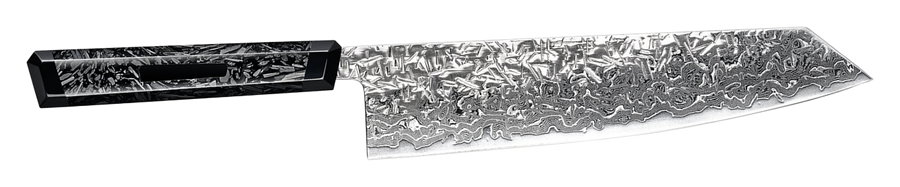
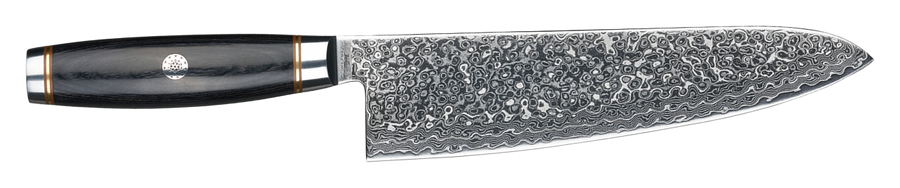
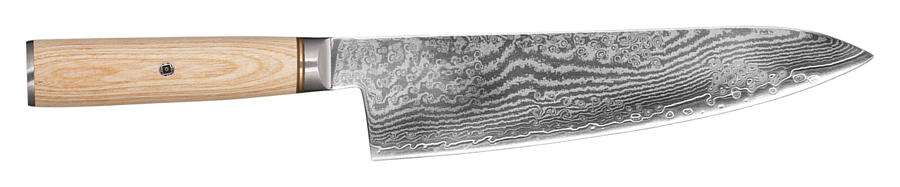
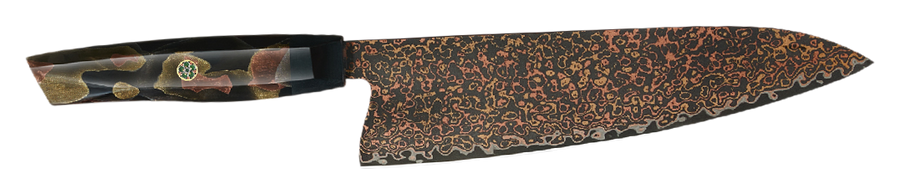
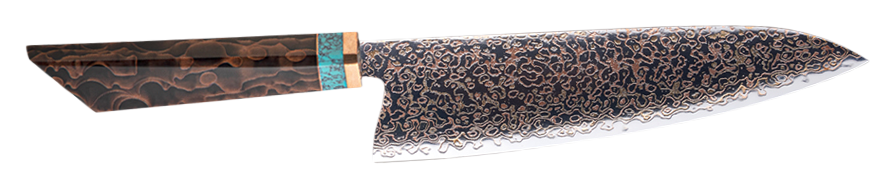
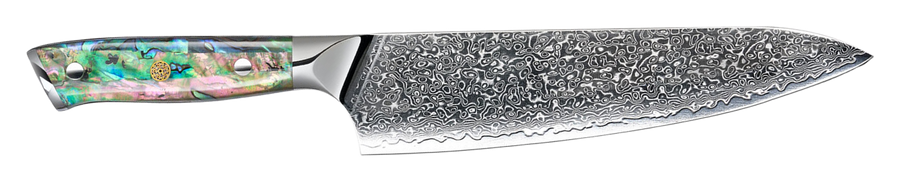
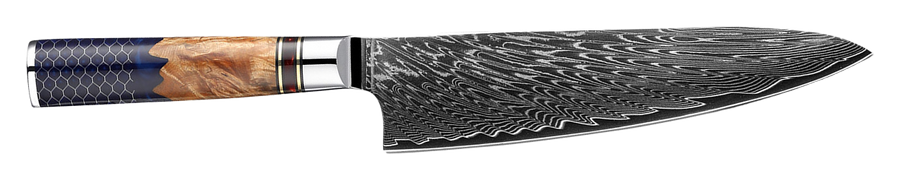
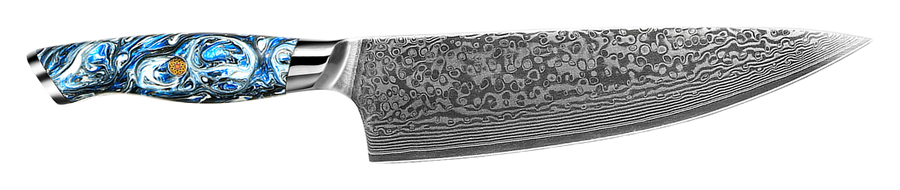
By collection: Magma and Azur are stated at 37 layers (10 knives), Marea, Iris, Cobalt, Carmin and Cosmos at 67 layers (44 knives). Magma shows a wide copper "diamond" pattern, the 67-layer collections fine, tight waves. The two honing rods in the catalog are carbon steel and are not sold as Damascus.
We write "stated by the manufacturer" because the layer count and hardness come from its technical sheet. 10Cr15CoMoV is a standard stainless steel with a composition close to VG10, easy to sharpen and stain resistant. To keep the pattern's contrast, skip abrasive scrubbers and the dishwasher; details in our Damascus knife care and sharpening guide.
To compare the two patterns side by side, see the Magma collection, 37 copper-toned layers and the Marea collection, 67 layers, or browse all Damascus knives.
 Magma · Damascus Chef Knife 8"$149
 Marea · Damascus Chef Knife 8"$99
 Cobalt · Damascus Chef Knife 9.5"$99
Frequently asked questions
How can you tell if a Damascus knife is real?
Start with the spine: on pattern-welded Damascus you can see fine parallel lines there, because the layers run through the steel. Then check the heel and the bright band along the edge, whose border follows the layers. A pattern that repeats exactly, a plain spine and a listing with no core steel or layer count all point to an imitation.
What is fake Damascus steel?
Fake Damascus is a blade cut from a single steel with a layer-like design laser-etched, acid-etched through a stencil or printed on its faces. The pattern exists only on the surface. Listings for these blades tend to say "Damascus pattern," "Damascus style" or "Damascus finish" rather than naming a pattern-welded steel and a core steel.
Does Damascus pattern wear off?
On real Damascus, the contrast comes from a surface acid etch, so polishing, abrasive scrubbers or sharpening can fade it in places, but the layers stay in the steel and the pattern returns over time or with a fresh etch. On a laser-etched or printed imitation, the pattern is gone for good wherever the abrasive touched it.
What does 67-layer Damascus mean?
67-layer Damascus usually means a hard steel core wrapped in 33 layers of Damascus on each side (1 + 33 + 33). It is the most common count: 211 of the 415 US listings that state a layer count in the Damascus Knife Price Survey (October 2026). The number changes the look of the blade, not how it cuts.
What is the difference between wootz and Damascus steel?
Wootz, the original Damascus steel, is a high-carbon crucible steel whose pattern comes from carbide bands in a single metal; the method for making it was lost. The Damascus on today's kitchen knives is pattern-welded steel: several steels forge-welded, folded and etched. The knife world has used the name Damascus for pattern-welded steel since 1973.
Is real Damascus steel better?
Not because of the Damascus itself. On a kitchen knife, the core steel and its heat treatment form the edge; the Damascus cladding protects and decorates. In a CATRA test, metallurgist Larrin Thomas found that a blade of about 200 layers cut right between the two steels it was made from, with no gain from pattern welding. Compare core steel and HRC first.
Sources
Updated November 8, 2026 · Method: history and metallurgy from the sources listed; general identification signs that apply to any knife; market figures from the Damascus Knife Price Survey of October 21, 2026 (529 listings, 15 US direct-to-consumer stores, information read from titles and descriptions); layer count and hardness of our blades as stated by the manufacturer.