






Quick answer
- Sharpening is two jobs: a honing rod realigns the edge, a whetstone removes steel and forms a new edge.
- Grit: #1000 to sharpen, #3000 to #6000 to refine. Coarse stones (#80 to #400) only for chips.
- Angle: follow the existing bevel. Kai (Shun) sharpens its Japanese-style knives at 16° per side and lists 20 to 25° per side for Western knives.
- Care: hand wash, dry right away, no dishwasher, wood or plastic board, never glass or stone.
- Stainless steel can still stain: spot-clean without abrasives so the Damascus pattern keeps its contrast.
To sharpen a Damascus knife, hone it on a rod before cooking or once a week, and when honing no longer brings back a clean cut, sharpen it on a #1000 whetstone and refine it on a #3000 to #6000 stone, holding the angle of the existing bevel. To care for it, hand wash, dry it immediately and keep it out of the dishwasher.
At Damascus Knife, all 54 knives have a 10Cr15CoMoV core rated 60 ± 2 HRC by the manufacturer: a stainless steel that sharpens easily on ordinary stones. The advice below is cross-checked with knife and whetstone makers.
Honing rod vs. whetstone: what each one does
A honing rod and a whetstone do two different jobs on a Damascus knife. The honing rod pushes the thin edge, which rolls over as you cut, back into line and removes almost no steel. The whetstone removes steel and forms a new edge once the old one has worn round. Honing delays sharpening; it never replaces it.
| Honing rod | Whetstone | |
|---|---|---|
| What it does | Realigns a rolled edge | Removes steel, forms a new edge |
| When | Before cooking, or about once a week at home | When honing no longer gives a clean cut |
| Time | A few seconds | Several minutes |
| Learning curve | Short | Longer: holding the angle |
| Limit | Useless on a rounded or chipped edge | Wears the blade down if overused |
Our product pages suggest a few light strokes per side before cooking; Kai, the maker of Shun knives, says once a week or so may be enough at home. Kai advises against diamond rods for routine honing: they remove metal, so they sharpen.
Damascus Knife sells two 8-inch honing rods with a ridged high-carbon steel rod: the Marea honing rod ($79, burl wood and blue resin handle) and the Iris honing rod ($89, abalone shell in resin). The product page describes the rod as long enough for every knife up to the chef knife; our 10-inch slicing knives run past it, so sweep them diagonally from heel to tip. Wipe the rod dry after use: high-carbon steel rusts.
The motion: rod upright, tip on a folded towel, blade at roughly the angle of the bevel, a few light strokes alternating sides. No force needed. A quick pass before carving the Thanksgiving turkey is exactly what the rod is for.
How to sharpen a Damascus knife on a whetstone
Sharpening a Damascus knife on a whetstone works like any double-bevel kitchen knife: a medium stone around #1000 forms a new edge, a fine stone from #3000 to #6000 polishes it and removes the burr, and the angle follows the original bevel. The patterned faces of the blade should never lie on the stone; only the edge bevel gets ground.
Tojiro, a knife maker that also sells whetstones, sorts grits into three families (table below) and says that for home cooking a medium stone alone already gives a good working edge.
| Grit | Job | When |
|---|---|---|
| #80 to #400 | Remove a lot of steel | Chip, broken tip, badly damaged edge |
| #600 to #2000 (usually #1000) | Routine sharpening, raise a burr | When honing is no longer enough |
| #3000 to #6000 | Refine the edge, remove the burr | After #1000 |
A #1000/#3000 or #1000/#6000 combination stone covers almost every home kitchen. Tojiro warns against jumping 3,000 grit or more between stones, or the finer stone struggles to erase the coarser scratches. For a Damascus-clad blade, the hardness of the core decides which stone suits it.
Step by step: soak or wet the stone as its maker says (some soak for 10 minutes, others are splash-and-go) and set it on a non-slip base. On #1000, push the blade edge-first from heel to tip with light pressure until you feel a small burr along the full length of the other side, then switch sides. Move to the fine stone with less pressure, alternating sides, until the burr fades. Rinse and dry both blade and stone. Never put oil on a water stone.
What angle should you sharpen a Damascus knife at?
The right sharpening angle for a Damascus knife is the one already on the blade: follow the existing bevel. For reference, Kai sharpens its Japanese-style Shun knives at 16° per side and lists 20 to 25° per side for German and other Western knives. There is no single correct angle for every Damascus knife.
The manufacturer of our blades does not publish an edge angle, and we will not make one up. The reliable method is the marker test: color the bevel with a permanent marker, make two light strokes on the stone, and look where the ink came off. If it only came off the top of the bevel, your angle is too low; if only at the very edge, too high. Holding the angle steady matters more than the exact number.
Why won't my knife get sharp?
Three causes come up again and again: the angle wobbles from stroke to stroke so the stone never reaches the apex; no burr forms along the full length because you switch sides too early; or the burr stays on and folds over at the first cut. The marker test, plus feeling for the burr with your thumb across (never along) the edge, solves most cases.
How often should you sharpen a Damascus knife?
How often a Damascus knife needs the whetstone depends on use, not on a calendar: the honing rod maintains the edge day to day, and the stone comes out when honing no longer restores a clean cut. Tojiro puts the point where an edge has clearly rounded at roughly one month of typical home use.
Two tests settle it. The paper test: hold a sheet of printer paper by its top edge and slice down through it; a sharp edge glides through, a dull one snags and tears. The tomato test: rest the edge on the skin with no pressure and draw it back lightly; a sharp knife bites on the first stroke, a dull one slides or crushes. If a few strokes on the rod get the knife through the test again, leave the stone in the drawer.
The 5 bread knives in our range have a serrated edge, and a serrated edge does not sharpen on a flat stone like a straight one. A tapered rod worked scallop by scallop, or a professional sharpening service, is the better route.
Pull-through sharpeners: why not for routine use
A pull-through sharpener brings back bite quickly, but it roughens the edge instead of forming a new one, and its fixed angle does not always match the blade's bevel. On a thin Damascus blade, we advise against it as a routine tool; a whetstone or a professional sharpener gives an edge that lasts.
Tojiro photographed edges under a microscope after a pull-through sharpener and after whetstones. Its finding: the pull-through does not really sharpen, it roughens the edge, which gives temporary bite; rely on it alone and the edge weakens to the point of cracking or chipping. For knives built to be very sharp, Tojiro says the crossed-blade type is better not used at all. Kai is more nuanced and accepts a pull-through as long as it matches the 16° angle of its own knives, so a gadget set up for Western knives is not made for a Japanese-style blade.
What to do if your knife has a chip
A small chip in a Damascus knife can be fixed on a whetstone: a coarse grit grinds the edge back to the bottom of the chip, then #1000 and a fine grit rebuild the edge. A deep chip or a broken tip is a job for a professional sharpening service, which removes the steel without overheating the blade.
Kai says its sharpening service grinds out chips of 2 mm (about 1/16 inch) or less; beyond that, the blade loses height. Usual causes on a hard blade: bones, pits, glass boards, twisting sideways. A thin, hard edge (60 ± 2 HRC as stated by the manufacturer for our blades) barely bends; it chips instead. Choosing the right blade shape for each task prevents most of this, as our guide santoku vs. chef knife explains.
If a chip is already there when your order arrives, contact us: that is a defect, and we cover the return shipping.
Daily care: washing, cutting boards, storage
Daily care for a Damascus knife takes four habits: hand wash it right after use, dry the blade and handle immediately, cut on wood or plastic, and store it in a block, on a magnetic strip or in a sheath. No special product is required.
| Habit | Do | Avoid |
|---|---|---|
| Washing | Warm water, soft sponge, a little dish soap, right after use | Dishwasher, soaking in the sink, the scrubby side of the sponge |
| Drying | Dry towel, blade then the blade-to-handle joint | Air-drying in the dish rack |
| Cutting board | Wood, kitchen-grade plastic | Glass, marble, granite, slate, ceramic plates |
| Storage | Knife block, magnetic strip, in-drawer tray, sheath | Loose in a drawer |
A dishwasher combines everything that hurts a knife: long heat, hours of moisture, harsh detergent and knocks against other dishes. Kai recommends against it for its knives, and so do our product pages. For boards, Kai offers a simple check: if the knife can leave a slight cut line in the board, the surface is soft enough. Kai goes further than we do and also rules out hard plastic and acrylic; wood is the best choice, polyethylene a common compromise. A knife thrown loose in a drawer gets dull or chipped, Kai notes.
Can a Damascus knife rust? Removing stains safely
A stainless Damascus knife can still show stains or spots of rust when moisture, salt or acid stays on the blade. Treat them early and locally with a mild cleaner, without steel wool or scouring pads, so the contrast of the Damascus pattern survives.
"Stainless" means corrosion resistant, not corrosion proof. Our blades have a stainless 10Cr15CoMoV core, yet any stainless steel left wet, or in contact with salt, lemon, tomato or vinegar, can pick up brown spots. Kai states that rust comes from moisture left on the blade and does not treat it as a manufacturing defect on its own stainless knives.
The pattern needs one extra precaution. On forge-welded Damascus, the contrast between light and dark layers is brought out in an acid bath that attacks the steels at different rates, as Chris Reeve Knives explains in its care guide. Abrasives, steel wool or metal polish wear that surface down and the pattern fades.
For a small spot: wash, dry, then treat only the affected area with a cotton swab and a mild cream cleanser, rinse and dry. That is the method Chris Reeve Knives describes (it names Soft Scrub), along with cleaning the blade after any contact with moisture and especially acidic foods. A drop of food-safe mineral oil on the dry blade protects it if the knife sits unused for a while. Re-etching exists, but the same maker warns it can only be done a few times and shortens the life of the blade: it is not maintenance.
Handle care: wood, resin, abalone or G10
A Damascus knife handle is cared for according to its material: burl wood with resin dislikes soaking and benefits from a drop of oil, while resin and G10 only need wiping. Whatever the material, dry the joint between blade and handle, where water collects.
Damascus Knife catalog · October 2026
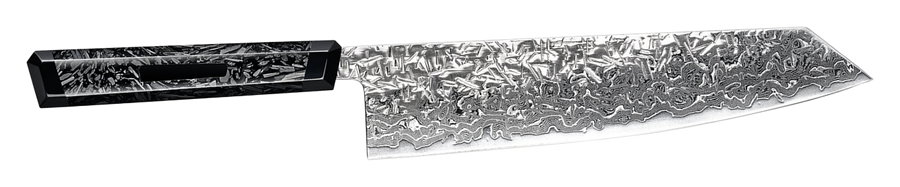
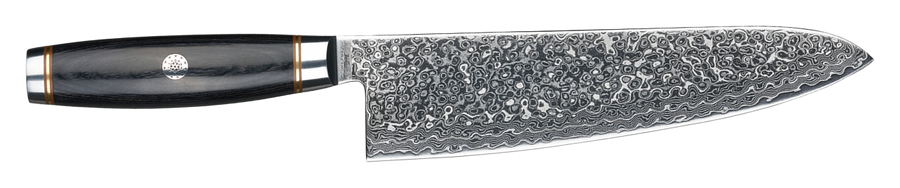
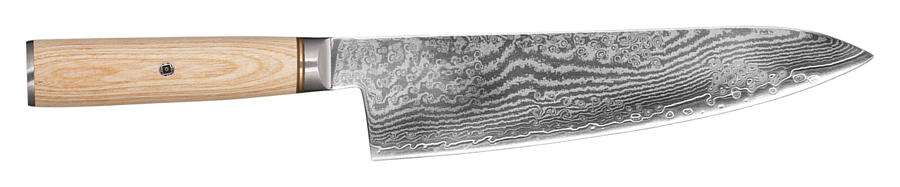
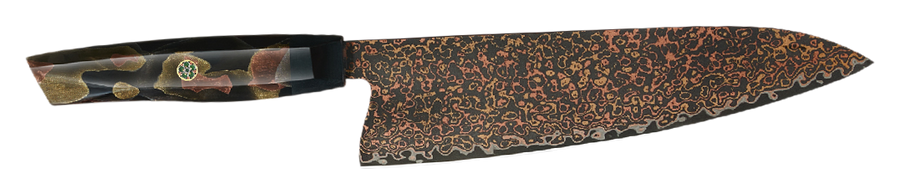
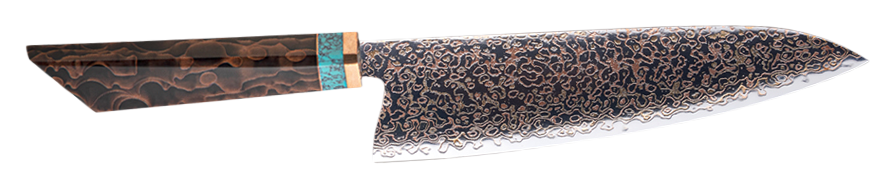
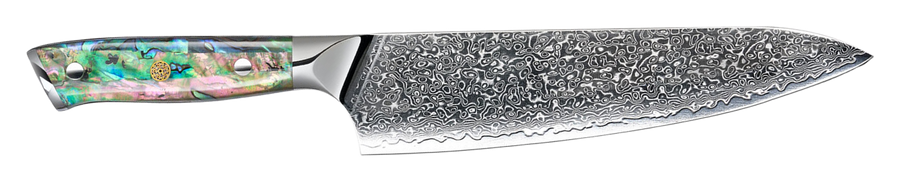
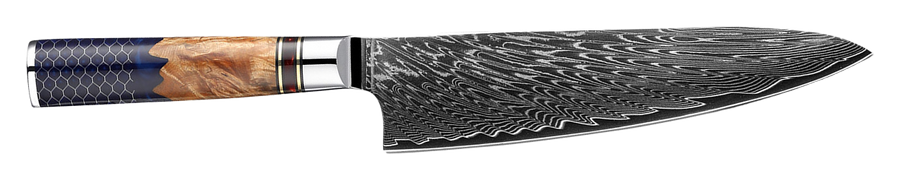
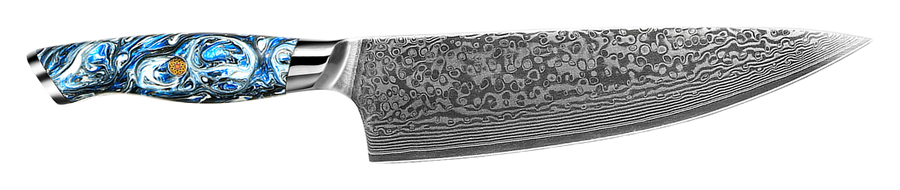
In the Damascus Knife catalog (54 knives and 2 honing rods, product pages reviewed in October 2026), half of the knives, 27 of 54, have a burl wood and resin handle (Marea, Cobalt and Carmin series), 12 an abalone shell in resin handle (Iris), 10 a resin handle (Azur, Cosmos) and 5 a G10 handle (Magma). 49 knives have a plain double-bevel edge and 5 bread knives a serrated edge.
| Handle | Series | Care |
|---|---|---|
| Burl wood and resin | Marea, Cobalt, Carmin | No soaking, dry right away, an occasional drop of food-safe oil on the wood |
| Abalone shell in resin | Iris | Soft sponge, dry; no solvents or abrasives, avoid knocks |
| Resin | Azur, Cosmos | Soft sponge, dry; keep away from a hot burner |
| G10, resin and copper weave | Magma | Sponge, dry; G10 does not swell or crack |
These materials are described on our product pages, but we publish no aging test: no long heat, no harsh chemicals, no soaking, and the handle keeps its looks. See the Marea blue resin series and the Iris abalone series.


Read next: how 10Cr15CoMoV, VG10 and SG2 differ in Damascus knife steel and layers, and what the market charges in how much a good Damascus knife costs. The full range is on the Damascus knives page.
Frequently asked questions
Can you sharpen a Damascus knife?
Yes. A Damascus knife sharpens like any double-bevel kitchen knife: hone it on a rod to realign the edge, and when that no longer works, sharpen it on a #1000 whetstone and refine it on a #3000 to #6000 stone. Only the edge bevel touches the stone, so the pattern on the faces of the blade is not affected by normal sharpening.
Can Damascus knives go in the dishwasher?
No. A dishwasher combines long heat, hours of moisture, harsh detergent and knocks against other dishes, which can stain the blade, chip the edge and damage the handle. Kai, the maker of Shun knives, recommends against it too. Hand washing in warm water with a little dish soap and drying right away takes less than a minute.
Do I need to oil my Damascus knife?
Not after every use. A stainless blade that is dried right away does not need oil day to day. A drop of food-safe mineral oil on the dry blade protects it if the knife will sit unused for a while, and a drop on a burl wood handle keeps the wood from drying out. Wipe off the excess before putting the knife away.
Can you use WD-40 on Damascus steel?
Some knife makers, including Chris Reeve Knives, mention WD-40 or a quality oil for Damascus blades, but that maker builds folding and outdoor knives. A kitchen knife touches food, so a food-safe mineral oil is the sensible choice. On a stainless kitchen blade, careful drying after every wash matters far more than any oil or protective spray.
What grit whetstone do I need for a Damascus knife?
A #1000/#3000 or #1000/#6000 combination whetstone covers almost every home kitchen. The #1000 side forms a new edge, the fine side polishes it and removes the burr. According to Tojiro, coarse stones from #80 to #400 are only needed to repair chips or reshape an edge. Pick the stone for the hardness of the blade's core steel.
How do you clean rust off a Damascus knife?
Act early and stay local. Wash and dry the blade, then work only the stained spot with a cotton swab and a mild cream cleanser, rinse and dry. Chris Reeve Knives describes this method. Avoid steel wool, scouring pads and metal polish on the faces of the blade: they wear down the etched surface and the Damascus pattern fades.
Sources
- Shun Knives FAQ (sharpening angle, honing, cutting boards, storage, chips), Kai USA
- 砥石の選び方 (Choosing a whetstone: grits and uses, in Japanese), Tojiro
- シャープナーと砥石の違い (Pull-through sharpener vs. whetstone: edges under the microscope, in Japanese), Tojiro
- How to Care for Damascus Blades, Chris Reeve Knives
Updated October 27, 2026 · Method: advice cross-checked against the knife and whetstone makers' guides listed in Sources; catalog figures computed from our 56 product pages (script entretien_stats.py).