






The short answer
- One knife for everything, including roasts, whole chickens and squash, and you rock the blade when you chop: get a chef's knife (8 to 9.5 in).
- Mostly vegetables, a small cutting board, and you push the blade forward instead of rocking: get a 7 in santoku.
- A nakiri only cuts vegetables, and does it very cleanly. It is a second knife, rarely the first.
- A santoku is not automatically lighter: in the Damascus Knife catalog it weighs between 0.6 oz less and 0.1 oz more than the chef's knife in the same series.
- According to the Damascus Knife Price Survey (October 2026), the median US price is $149 for an 8 in (20 to 22 cm) Damascus chef's knife, $109.50 for a santoku and $149 for a nakiri.
Buy a chef's knife if you want one knife that handles everything, meat included, and you chop with a rocking motion. Buy a santoku if you mostly prep vegetables on a small board and cut by pushing the blade forward; a nakiri is a vegetable specialist you add later.
What is the difference between a santoku, a chef's knife and a nakiri?
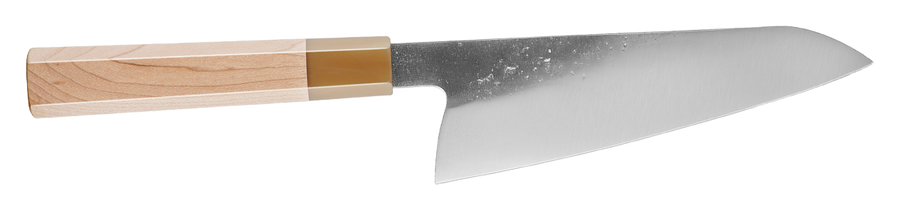
A chef's knife, a santoku and a nakiri differ in three ways: blade length, edge curve and tip shape. The chef's knife is long, curved and pointed. The santoku is shorter and nearly flat, with a dropped tip. The nakiri is rectangular, straight along its whole edge, and has no point at all.
Those shapes decide how you cut. A curved edge rolls on the board; a flat edge lands flat. The table puts typical market sizes next to the real specs of our three Magma knives, taken from their product pages.
| Feature | Chef's knife | Santoku | Nakiri |
|---|---|---|---|
| Typical blade length | 8 to 10 in | 5 to 7 in | 6 to 8 in |
| Edge | Curved, with a belly | Nearly flat, curving near the tip | Straight from heel to tip |
| Tip | Pointed, raised | Dropped ("sheep's foot") | Square or rounded, no point |
| Main motion | Rock chop: the tip stays on the board | Push cut forward, straight down chop | Straight down chop or push cut |
| Best for | Everything, including roasts, poultry, squash, rocking through herbs | Vegetables, boneless meat and fish, everyday prep | Vegetables only |
| Board and kitchen | Large board, clear counter | Works on small boards | Works on small boards |
| Our Magma knives: blade / height | 8 in (21 cm) / 2.1 in | 7 in (18 cm) / 1.9 in | 7 in (18 cm) / 1.9 in |
| Our Magma knives: overall length / weight | 13.5 in / 6.2 oz (175 g) | 12.5 in / 5.7 oz (162 g) | 12.6 in / 6.1 oz (174 g) |
| Magma price at Damascus Knife | $149 | $149 | $149 |

One note on blade height: you often read that a santoku has a taller blade than a chef's knife. On our Magma knives it is the other way around: 2.1 in (54 mm) for the 8 in chef's knife, 1.9 in (48 mm) for the 7 in santoku and nakiri. Height depends on the model more than on the knife type.
Rock chop or push cut: which motion fits you?
Your cutting motion is the real deciding factor between a santoku and a chef's knife. A chef's knife is built to rock: the tip stays down while the heel rises and falls. A santoku and a nakiri are built to push cut: the blade travels forward and down, flat, and leaves the board after each cut.
If you learned to mince onions and herbs by rocking, a santoku will frustrate you, because its dropped tip leaves little curve to roll on. America's Test Kitchen made the same point: in their santoku testing they preferred models with a pointier tip that could work more like a chef's knife.
The other way around, if you naturally chop straight down, an 8 in chef's knife can feel long and pointy at first. A 7 in santoku gives you more control and fits a smaller board.
The nakiri takes the push cut all the way. Its straight edge meets the board along its full length, so a slice of carrot or leek is cut clean through instead of staying attached to the next one. In exchange, it cannot rock at all and has no point for scoring.
Gyuto vs santoku: is a gyuto just a chef's knife?
A gyuto is the Japanese form of the chef's knife: the same pointed tip and curved belly, usually with a thinner, harder blade than a classic German chef's knife. Comparing a gyuto with a santoku is therefore the same decision as chef's knife vs santoku: rocking and length on one side, push cutting and compactness on the other.
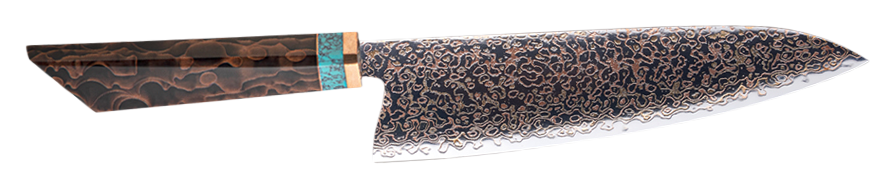
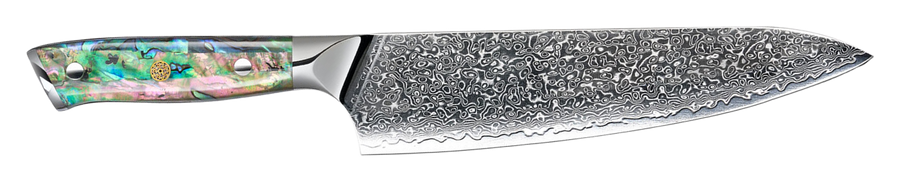
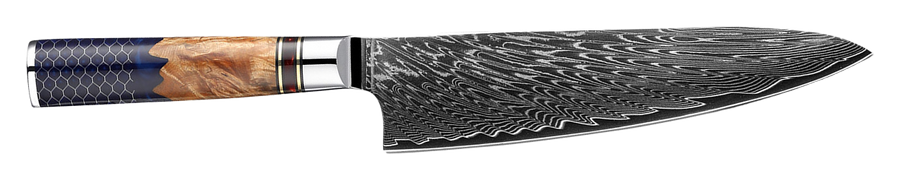
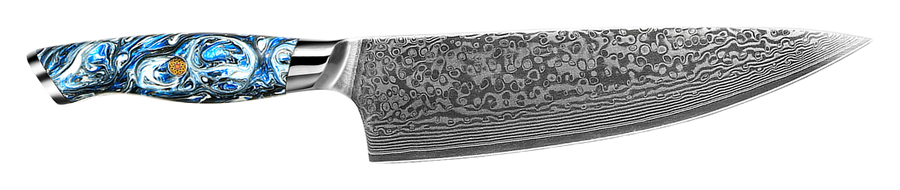
Our chef's knives are Japanese-style with a double bevel; the Magma 8 in, for example, has the pointed tip and curved belly of a gyuto. They come in 8 in (Magma, Azur, Iris, Cosmos, Marea, Cobalt, Carmin), 9 in (Marea) and 9.5 in (Cobalt, Carmin).
If you already own a gyuto you like, a santoku adds little. A nakiri or a small knife adds more, because they do things the gyuto does less well.
Is a santoku lighter than a chef's knife?
A santoku is usually described as much lighter than a chef's knife. In the Damascus Knife catalog the gap is small: within one series, the santoku weighs between 0.6 oz less and 0.1 oz more than the chef's knife, while the same knife type varies by 2.8 oz from one series to another.
Damascus Knife catalog · product page weights, October 2026
Across the six series that list a weight, the 7 in santoku weighs from 5.7 oz (Magma, 162 g) to 8.5 oz (Cosmos, 242 g), and the 8 in chef's knife from 6.2 oz (Magma, 175 g) to 8.5 oz (Iris, 242 g). The nakiri weighs 0.3 to 1 oz (9 to 29 g) more than the santoku in the same series.
| Series | Chef's knife | Santoku 7 in | Nakiri |
|---|---|---|---|
| Magma (G10 and copper) | 6.2 oz (8 in) | 5.7 oz | 6.1 oz (7 in) |
| Azur (resin and brass) | 6.7 oz (8 in) | 6.1 oz | 6.5 oz (7 in) |
| Cobalt and Carmin (wood and resin) | 7.1 oz (8 in) | 7.0 oz | 8.0 oz (7 in) |
| Iris (abalone under resin) | 8.5 oz (8 in) | 8.0 oz | 8.4 oz (6.5 in) |
| Cosmos (galaxy resin) | 8.5 oz (8 in) | 8.5 oz | no nakiri |
The practical takeaway: if weight matters to you, because of your wrist or long prep sessions, pick the series first and the knife type second. A 6.2 oz Magma chef's knife is lighter than an 8.0 oz Iris santoku. For reference, Stiftung Warentest, the German consumer testing foundation, weighed most classic chef's knives in its 2014 test at 7.4 to 9.9 oz (210 to 280 g) and its santokus at 4.6 to 8.5 oz (130 to 240 g).
Which knife should you buy?
Choosing between a chef's knife, a santoku and a nakiri comes down to four questions: what you cut most, how big your cutting board is, how you cut, and how many knives you want to own. Go through them in order; the first clear answer settles it.
- You often break down big items (a roast, a whole chicken, butternut squash, a head of cabbage, the Thanksgiving turkey): chef's knife, 8 in for most kitchens, 9 or 9.5 in if you have counter space.
- You cook mostly vegetables, with some boneless meat and fish: 7 in santoku.
- Your board is small, your kitchen is tight, or an 8 in blade feels like too much: 7 in santoku, or a 5 in petty santoku for small jobs.
- You already own an all-purpose knife and prep a lot of vegetables every day: a nakiri as your second knife.
- You want a fine point for scoring and you slice meat or fish in one long stroke: look at the kiritsuke.
For a first knife with no special constraint, our view is simple: the chef's knife covers the most tasks, the santoku is the easiest to get comfortable with. Both are good picks; a nakiri on its own is not.
Browse by type: Damascus chef knives, Damascus santoku knives and Damascus nakiri knives.
Do you need both a santoku and a chef's knife?
You do not need both a santoku and a chef's knife: the two knives do most of the same work. A more useful pair combines two shapes that complement each other, one all-purpose knife (chef's knife or santoku) plus a nakiri for vegetables, or one all-purpose knife plus a small knife for in-hand work.
Owning both makes sense in three cases: two people cook with different techniques, you want a long knife for meat and a shorter one for prep, or you regularly cook big batches of vegetables and meat on the same day.
If you are starting from scratch, buy one all-purpose knife and add a second one when a specific need shows up. It costs less, and you will know exactly which shape you are missing.
Petty santoku and kiritsuke: who are they for?
The petty santoku and the kiritsuke are two variants for specific needs. The 5 in petty santoku is a short santoku for small prep and small hands. The kiritsuke, with its angled tip, handles like a chef's knife but with a flatter edge that favors long slicing strokes over rocking.
At Damascus Knife, the Iris 5 in petty santoku weighs 4.7 oz (134 g) and costs $99. It is right for a shallot, a tomato or a chicken breast, and it pairs well with a chef's knife. It does not replace a 7 to 8 in knife for squash or a roast.
The Iris 8 in kiritsuke (8.4 oz, $129) is for cooks who slice meat and fish in one pass and want a fine point for scoring. Its flatter edge rocks less than a chef's knife, so if you mince a lot of herbs by rocking, the chef's knife stays more comfortable.
How much do Damascus santoku, chef and nakiri knives cost?
In the US, Damascus santoku knives sell for less than chef's knives and nakiri knives. According to the Damascus Knife Price Survey (October 2026, 529 listings from 15 US direct-to-consumer stores), the median price is $149 for an 8 in Damascus chef's knife, $109.50 for a Damascus santoku and $149 for a Damascus nakiri.
Damascus Knife Price Survey · October 2026
Survey of listed prices on October 21, 2026 for Damascus kitchen knives sold individually by 15 US direct-to-consumer stores (529 listings). Medians: chef's knife 8 to 8.7 in (20 to 22 cm) $149 (n = 80), santoku $109.50 (n = 56), nakiri $149 (n = 47). With a VG10 or AUS10 core only: chef's knife $150 (n = 39), santoku $149 (n = 23), nakiri $159 (n = 17).
At Damascus Knife, all three types cost the same within a series: $149 for Magma and Azur, $129 for Iris, $99 for Marea, Cobalt and Carmin. Shipping is free and US import duties and taxes are included. The knife type does not change your budget, only the way you cut.
Whichever shape you pick, all 56 knives in the catalog share the same stainless 10Cr15CoMoV core, with a hardness of 60 ± 2 HRC as stated by the manufacturer: easy to care for and easy to sharpen. Prices by steel tier are in our guide how much a good Damascus knife costs, and steel and layer counts are explained in Damascus knife steel and layers.
Whichever type you pick, a thin blade is cared for the same way: hand wash, no dishwasher, dry right away, cut on wood or plastic, and keep the edge up with a honing rod or a whetstone. The details are in how to care for and sharpen a Damascus knife.
To build on this first knife, our guide to the essential kitchen knives explains the basic trio (a large knife, a small knife and a bread knife) and which one to buy first.
 Magma · Damascus Chef Knife 8"$149
 Magma · Damascus Santoku Knife 7"$149
 Magma · Damascus Nakiri Knife 7"$149
 Marea · Damascus Santoku Knife 7"$99
Frequently asked questions
Should I buy a santoku or a chef knife?
Buy a chef's knife if you want one knife for everything, including roasts and whole poultry, and you chop with a rocking motion. Buy a santoku if you mostly cook vegetables, work on a small board and cut straight down or forward. For a first knife, the chef's knife covers more tasks and the santoku is easier to get comfortable with.
Can I use a santoku knife for everything?
A santoku handles most everyday prep: vegetables, herbs, boneless meat, fish fillets. It is less comfortable for large items like a whole chicken, a big roast or a winter squash, where a longer chef's knife helps, and it does not suit rock chopping. Like any thin, hard blade, it should never be used on bones or frozen food.
Do I need both a nakiri and a santoku?
Only if you prep a lot of vegetables. A nakiri's straight edge cuts every slice cleanly through, but a santoku already does most of that job. A nakiri makes more sense next to a chef's knife or gyuto, because the two shapes and cutting motions are very different and cover each other's weak spots.
What three knives should every kitchen have?
Three knives cover nearly everything: an all-purpose knife (chef's knife or santoku), a paring or utility knife for in-hand work, and a serrated bread knife for bread and crusty loaves. A nakiri, slicing knife or cleaver comes after that, depending on what you cook most often.
Do I need a santoku if I have a gyuto?
Usually not. A gyuto is the Japanese form of the chef's knife and already does most of what a santoku does, with extra length for big items and a curve for rocking. If you want to add a second knife to a gyuto, a nakiri for vegetables or a small petty or paring knife adds more than a santoku.
What are gyuto knives good for?
A gyuto is a general-purpose knife, usually 8 to 9.5 inches, with a pointed tip and a curved belly. It slices meat and fish, minces herbs by rocking, dices onions and breaks down large vegetables. Its length and point make it the most versatile single knife for cooks who handle a lot of protein.
Sources
Updated October 27, 2026 · Method: specs from the Damascus Knife catalog product pages (weight, lengths, blade height); median prices from the Damascus Knife Price Survey of October 21, 2026, 529 US listings.