






The short answer
- A paring knife (3 to 4 in) works mostly in your hand: peeling, hulling, coring, deveining, scoring.
- A utility knife (5 to 6 in) works on the cutting board: limes, shallots, salami, hard cheese, a small chicken breast.
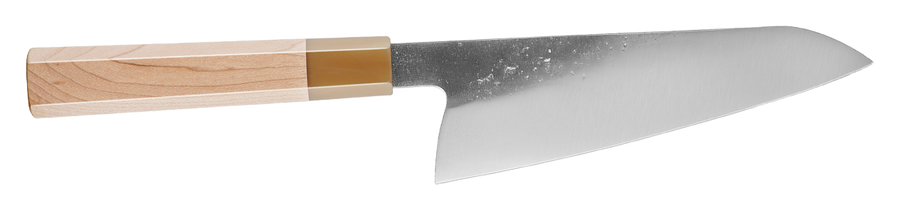
- A petty santoku (5 in) is a shortened santoku: flat edge, dropped tip, cut by pushing the blade forward.
- If you already own a chef's knife, buy a paring knife first. If you have no big knife and cook small amounts, get a utility knife or a petty santoku.
- According to the Damascus Knife Price Survey (October 2026), the median US price is $69.97 for a Damascus paring knife (n = 48) and $89.99 for a Damascus utility knife (n = 50).
A paring knife is for precise work done in your hand, a utility knife is for small cuts on the board, and a petty santoku makes those same board cuts with a flat blade you push forward. If you already have a chef's knife, a paring knife is the most useful addition; if you want one small knife for everyday tasks, choose the utility knife.
Paring knife vs utility knife vs petty santoku: what is the difference?
A paring knife, a utility knife and a petty santoku differ in blade length and in where you cut. The paring knife, 3 to 4 inches long, is used in the hand. The utility knife, roughly 5 to 6 inches, cuts on the board. The petty santoku, about 5 inches, also cuts on the board, but with a flat edge and a dropped tip.
Wikipedia puts paring knives at 6 to 10 cm (2 to 4 in) and kitchen utility knives at 10 to 18 cm (4 to 7 in). In the Damascus Knife Price Survey, the median listed blade length is 3.5 inches for paring knives (45 listings with a length) and 5.2 inches for utility knives (47 listings).
| Feature | Paring knife | Utility knife | Petty santoku |
|---|---|---|---|
| Typical blade length | 3 to 4 in | 5 to 6 in | 5 to 6 in |
| Shape | Short, pointed blade | Narrow, pointed blade, like a small chef's knife | Flat edge, dropped tip |
| Where you cut | In hand, sometimes on the board | On the board | On the board |
| Main motion | Peeling, coring, scoring with the tip | Slicing, mincing, trimming | Push cut forward, straight down chop |
| Typical tasks | Apples, strawberries, garlic, shrimp, scoring meat | Limes, shallots, tomatoes, salami, hard cheese, small fillets | Shallots, tomatoes, fruit, chicken breast |
| Our knives: blade | 3 or 3.5 in | 5 or 6 in | 5 in |
| Our knives: weight (product pages) | 3.1 to 3.7 oz (87 to 105 g) | 3.5 to 4.1 oz (100 to 117 g) | 4.7 oz (134 g) |
| Price at Damascus Knife | $69 to $89 | $79 to $129 | $99 |

Two naming notes. "Petty" comes from the French word petit, small: a petty knife is a utility knife or a long paring knife depending on its length, not a fourth type. And outside the kitchen, "utility knife" also means a box cutter with snap-off blades, which is why many stores write "kitchen utility knife".
What is a paring knife used for?
A paring knife is used for small, precise jobs, most of them done in your hand rather than on a cutting board: peeling an apple, hulling strawberries, pulling the green germ out of a garlic clove, seeding a bell pepper, deveining shrimp, scoring meat. The short blade puts your fingers right behind the tip, which is where the control comes from.
A paring knife also handles the jobs a big knife makes awkward: poking a potato to check if it is done, cutting citrus into segments, splitting a vanilla bean. America's Test Kitchen lists the same tasks in its paring knife review, both on and off the board, and counts the paring knife among the three knives every home cook should own, with a chef's knife and a serrated bread knife.
Its limits come from its size. A 3-inch blade will not take a whole onion, a squash or a roast through in one clean pass. Like any thin blade, it is not for bones or frozen food. Come Thanksgiving, it is the knife for coring and peeling pie apples, not for carving the turkey.
On length, America's Test Kitchen notes that most paring knives have 3 to 4 inch blades and that its testers preferred 3 to 3.5 inches for in-hand work. At Damascus Knife, the paring knives measure 3 inches (Cobalt and Carmin) and 3.5 inches (Marea, Cosmos and Iris).
What is a kitchen utility knife used for?
A kitchen utility knife is used for medium cuts on the board, too small to bother with a chef's knife and too big for a paring knife: cutting limes into wedges, mincing a shallot, slicing salami or a firm cheese, trimming a chicken breast. It sits between the paring knife and the chef's knife in size, and it is often the knife you reach for most during the day.
Sandwiches, snack plates, a quick cheese board: a 5-inch utility knife covers them. America's Test Kitchen puts it on its list of bonus knives after the three essentials, and names slicing tomatoes, mincing shallots, and slicing salami and firm cheese as its typical jobs. Some utility knives are serrated, a style close to the tomato knife.
The narrow blade has two consequences. It leaves little knuckle clearance above the board when you mince a lot, and it does not rock as well as a chef's knife. For a big pile of vegetables, a 7 to 8-inch knife is still faster.
Damascus Knife catalog · product pages, November 2026
The Damascus Knife catalog has 13 small knives: 5 paring knives of 3 to 3.5 inches (3.1 to 3.7 oz), 7 utility knives of 5 to 6 inches (3.5 to 4.1 oz) and 1 petty santoku of 5 inches (4.7 oz). The utility knife comes in all 7 series, the paring knife in 5 series (not in Magma or Azur).
Our longest model is the Iris 6-inch utility knife (3.9 oz, $99); the others are 5 inches. Six inches suits you if you slice a lot of salami or cheese, five inches if you mainly want a nimble knife.
Who is a petty santoku for?
A petty santoku is a shortened santoku: a nearly flat edge, a dropped tip, and a cut made by pushing the blade forward. A petty santoku does the same board work as a utility knife, but with the santoku motion. It suits cooks who like that motion, smaller hands, and small kitchens where a 7-inch knife feels too big.
At Damascus Knife, the Iris 5-inch petty santoku weighs 4.7 oz (134 g) and costs $99, 0.8 oz (23 g) more than the Iris 6-inch utility knife (111 g). That extra weight helps a straight down chop through a shallot, a tomato or a chicken breast.
A petty santoku does not replace a paring knife: the dropped tip is not made for peeling in hand or for scoring. It does not replace a 7-inch santoku for a cabbage or a squash either. The differences between santoku, chef's knife and nakiri are covered in our guide santoku vs chef knife.
Paring knife or utility knife: which one should you buy?
Choosing between a paring knife, a utility knife and a petty santoku depends on the knife you already own and on where you cut. If you own a chef's knife, a paring knife adds the most. If you have no big knife and cook small amounts, a utility knife or a petty santoku adds the most.
- You already have a chef's knife or a 7-inch santoku: a 3 to 3.5-inch paring knife. It does in your hand what the big knife cannot.
- You often cut small things on the board (limes, cheese, salami, fruit for snacks): a 5 to 6-inch utility knife.
- You cut by pushing the blade forward, or a narrow knife feels unstable: the 5-inch petty santoku.
- You want only one small knife: the utility knife, which covers the board and, held close to the heel, part of the in-hand work.
- You peel a lot of fruit and vegetables by hand: the paring knife, even if you already have a utility knife.
Our take: the most useful pair is still a 7 to 8-inch all-purpose knife plus a paring knife. The utility knife comes next, once you notice you are pulling out the big knife to cut a lime. All the small models are in our Damascus paring and utility knives collection, the large ones in Damascus chef knives.
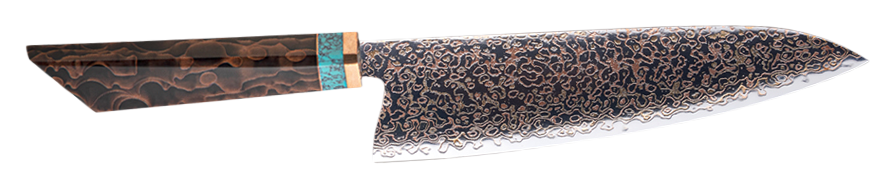
 Cobalt · Damascus Paring Knife 3"$69
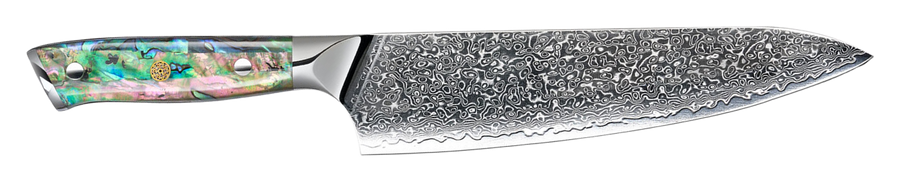
 Marea · Damascus Utility Knife 5"$79
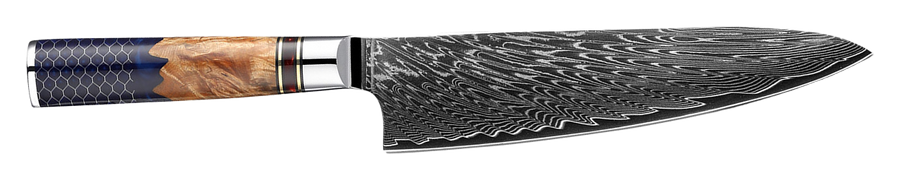
 Iris · Damascus Petty Santoku 5"$99
How much does a Damascus paring knife cost?
A Damascus paring knife costs a median of $69.97 in the US, and a Damascus utility knife $89.99, according to the Damascus Knife Price Survey (October 2026, 529 single-knife listings from 15 US stores). At Damascus Knife, the Marea, Cobalt and Carmin paring knives cost $69 and the Marea, Cobalt, Carmin and Cosmos utility knives $79, both below those medians.
Damascus Knife Price Survey · October 2026
Survey of displayed prices for Damascus kitchen knives sold individually by 15 US direct-to-consumer stores, collected on October 21, 2026 (529 listings). Paring knives: median $69.97 (n = 48). Utility knives: median $89.99 (n = 50), $89.95 for a 4.5 to 6-inch blade (n = 47). 31 of the 48 paring knives (64.6%) are listed at $69 or more, and 31 of the 50 utility knives (62.0%) at $79 or more.
| Damascus Knife model | Blade | Price | Listings of the same type at the same price or higher |
|---|---|---|---|
| Paring knife Cobalt, Carmin or Marea | 3 or 3.5 in | $69 | 64.6% (31 of 48) |
| Utility knife Marea, Cobalt, Carmin or Cosmos | 5 in | $79 | 62.0% (31 of 50) |
All 13 small knives have the same stainless 10Cr15CoMoV core as our larger knives, with a manufacturer-stated hardness of 60 ± 2 HRC, 37 Damascus layers in Magma and Azur and 67 layers in the other series (manufacturer figures). The price changes with the handle and the series, not with the steel. Prices by steel and knife type are broken down in our guide how much a good Damascus knife costs, and the steels are compared in Damascus knife steel and layers.
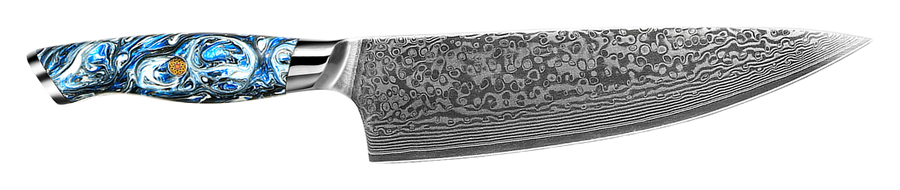
 Iris · Damascus Paring Knife 3.5"$89
 Magma · Damascus Utility Knife 5"$129
 Iris · Damascus Utility Knife 6"$99
How do you care for a small Damascus knife?
A small Damascus knife is cared for like a big one: wash by hand, dry right away, keep it out of the dishwasher, and cut on a wood or plastic board. The tip of a paring knife is the thinnest part of the blade; it is not a screwdriver or a can opener, and it should not scrape across the board.
Store the paring knife on its own, in a block or on a magnetic strip, rather than loose in a drawer where the tip knocks against other tools. Hone it on a honing rod or sharpen it on a whetstone like your other knives; the details are in our guide Damascus knife care and sharpening.
A paring knife or a utility knife is an easy holiday gift to pair with a chef's knife someone already owns. For delivery before Christmas in the US, order by Tuesday, December 1; gift ideas by budget are in our guide giving a knife as a gift.
Frequently asked questions
What is a paring knife used for?
A paring knife is used for small, precise jobs, mostly done in your hand: peeling apples, hulling strawberries, removing the germ from garlic, seeding peppers, deveining shrimp, scoring meat and poking potatoes to check if they are done. The 3 to 4-inch blade puts your fingers close to the tip. It is not made for whole onions, squash, bones or frozen food.
What is the difference between a paring knife and a utility knife?
A paring knife has a 3 to 4-inch blade and works mostly in your hand: peeling, hulling, scoring. A kitchen utility knife has a blade of roughly 5 to 6 inches and works on the cutting board: limes, shallots, salami, firm cheese, small fillets. The utility knife sits between the paring knife and the chef's knife; the paring knife is more precise, the utility knife more versatile.
What is a petty knife?
Petty comes from the French word petit, meaning small. A petty knife is a small Japanese-style kitchen knife; depending on its length, it works as a long paring knife or a utility knife. It is not a separate fourth type. A petty santoku is different: it keeps the santoku shape, with a flat edge and a dropped tip, in a blade of about 5 inches.
Do I need a paring knife if I have a chef's knife?
Yes, it is the most useful addition. An 8-inch chef's knife is too long for in-hand work like peeling an apple, coring a tomato or hulling strawberries, and a 3 to 3.5-inch paring knife handles exactly those jobs. America's Test Kitchen counts the paring knife among the three knives every home cook should own, with a chef's knife and a serrated bread knife.
What size paring knife is best?
Most paring knives have blades of 3 to 4 inches. America's Test Kitchen testers preferred 3 to 3.5 inches for the most control when peeling and hulling in hand, while a longer blade handles bigger food on the board. In the Damascus Knife Price Survey (October 2026), the median listed blade length for Damascus paring knives is 3.5 inches (45 US listings).
How much does a good Damascus paring knife cost?
According to the Damascus Knife Price Survey (October 2026, 529 single-knife listings from 15 US stores), a Damascus paring knife sells for a median of $69.97 (n = 48) and a Damascus utility knife for $89.99 (n = 50). At Damascus Knife, paring knives start at $69, with a 10Cr15CoMoV core and a manufacturer-stated hardness of 60 ± 2 HRC.
Sources
Updated November 4, 2026 · Method: lengths, weights and prices from the Damascus Knife catalog product pages; median prices and price positions calculated from the Damascus Knife Price Survey of October 21, 2026, 529 US listings (script petits_couteaux.py).