






The short answer
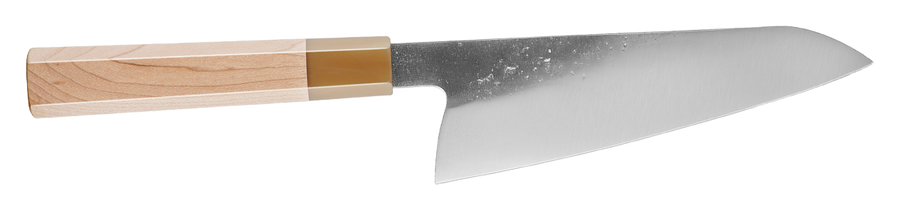
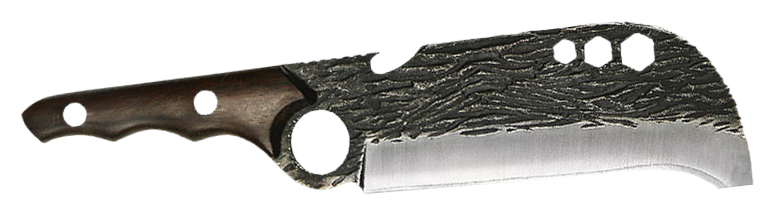
- "Cleaver" covers two different knives: the Chinese cleaver, a wide but thin blade used as an everyday chef's knife, and the meat cleaver, a thick, heavy blade that splits bone with its weight.
- A Chinese cleaver slices, dices and minces vegetables, herbs, garlic and meat, and its wide blade doubles as a scoop. It is not for hacking through hard bone.
- Most meat cleavers have a spine 3 to 6 mm thick, according to America's Test Kitchen, and a deliberately blunter edge.
- Damascus Knife cleavers (7.5 in) are Chinese-style cleavers: 2 to 2.3 mm spine, 9.3 to 10.4 oz. Their product pages say they handle cartilage and small soft bones, not large hard bones.
- According to the Damascus Knife Price Survey (October 2026, 29 listings from US direct-to-consumer stores), a Damascus cleaver sells for a median of $129.99.
A Chinese cleaver is an all-purpose kitchen knife with a tall, rectangular, thin blade: it cuts vegetables, herbs and boneless meat, then scoops up what it cut. A meat cleaver is a butcher's tool, thick and heavy, built to split bone by force; the two share a silhouette, not a job.
Chinese cleaver vs meat cleaver: what is the difference?
The Chinese cleaver and the meat cleaver look alike, with a tall rectangular blade, but differ in thickness, weight and edge angle. The Chinese cleaver, called caidao ("vegetable knife"), is a thin chef's knife. The meat cleaver is thick and heavy and cuts by chopping down hard.
Wikipedia puts it plainly: the Chinese chef's knife is often wrongly called a cleaver because of its shape, yet it is used like a French chef's knife or a santoku. Chinese knives fall into three families by blade thickness: thin slicers, all-purpose choppers that are a little thicker, and heavy bone cleavers called gudao.
| Feature | Thin Chinese cleaver (slicer) | All-purpose Chinese cleaver (chopper) | Meat cleaver |
|---|---|---|---|
| Blade thickness | Thinnest | A little thicker | Thick: 3 to 6 mm at the spine on most meat cleavers |
| Edge | Fine, like a chef's knife | Fine, like a chef's knife | Deliberately blunt, around 25° |
| Motion | Push cut, thin slices | Push cut, quick chopping | Hard downward chop, the weight does the work |
| Vegetables, herbs, garlic | Yes | Yes | Possible, but heavy and imprecise |
| Boneless meat, fish | Yes, in thin strips | Yes | Rough cuts only |
| Bones | Never | Thin, soft bones only (poultry, fish) | Yes: pork ribs, joints, carcasses |
Table sources: Wikipedia's "Chinese chef's knife" and "Cleaver" articles and America's Test Kitchen's 2026 cleaver review. Exact numbers vary by maker. The logic does not: the thinner the blade, the cleaner it cuts and the less impact it can take.
The Damascus Knife cleaver: what the product page says
Damascus Knife cleavers are 7.5 inch Chinese-style cleavers with a wide, tall blade. According to their product pages, they slice, chop and double as a scoop to carry food from board to pan, mince herbs, garlic and meat with little effort, and handle cartilage and small soft bones.
The product page is just as clear about the limit: for large hard bones, use a saw, because a heavy blow can chip the edge. That rule applies to any thin, hard blade, and our cleavers carry the same blade as our other knives: 67-layer Damascus around a 10Cr15CoMoV core, 60 ± 2 HRC, both as stated by the manufacturer.
| Series | Blade | Overall length | Spine | Weight | Handle | Price |
|---|---|---|---|---|---|---|
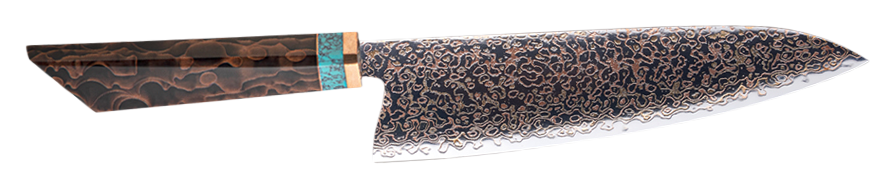
| Marea | 7.5 in | not listed | not listed | not listed | Burl wood and blue resin | $99 |
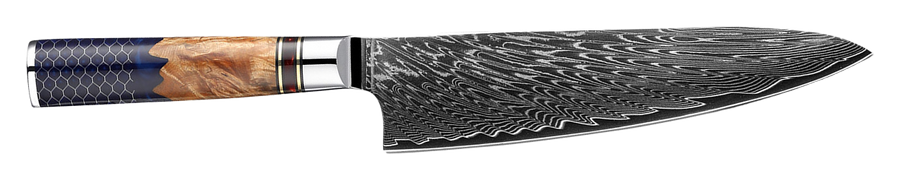
| Cobalt | 7.5 in | 12.9 in | 2 mm | 9.3 oz | Burl wood and honeycomb midnight blue resin | $99 |
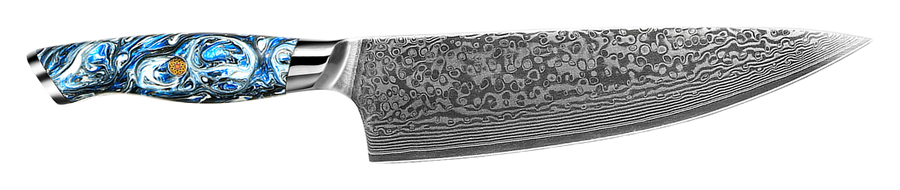
| Carmin | 7.5 in | 12.9 in | 2 mm | 9.3 oz | Burl wood and red resin | $99 |
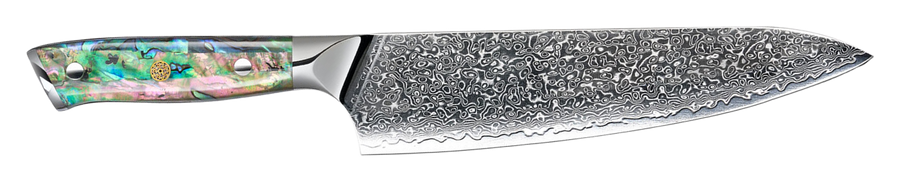
| Iris | 7.5 in | 13.1 in | 2.3 mm | 10.4 oz | Abalone shell under resin | $139 |

Damascus Knife catalog · product page specs, November 2026
Within a series, the cleaver has the same listed spine thickness as the chef's knife: 2 mm in Cobalt and Carmin (2.3 mm vs 2.1 mm in Iris). It weighs 2.2 oz (62 g) more than the Cobalt and Carmin 8 inch (19 cm) chef's knife (263 g vs 201 g), and 1.9 oz (54 g) more than the Iris 8 inch chef's knife (296 g vs 242 g). The extra weight comes from blade height, not thickness.
In use, that extra weight helps when you chop: the blade drops with less effort from you. The thickness stays that of a chef's knife, so it still cuts cleanly through an onion or a tomato. For reference, America's Test Kitchen notes that most meat cleavers measure 3 to 6 mm at the spine.
What is a Chinese cleaver used for?
A Chinese cleaver handles almost all prep work: slicing and julienning vegetables, mincing herbs, garlic and ginger, cutting boneless meat and fish into thin strips for stir-fries, smashing garlic with the flat of the blade, then scooping everything into the pan or wok.
- Slice. Push the blade forward, its flat side resting against the curled knuckles of your guiding hand. The tall blade gives you a wide, steady guide.
- Mince. Short, quick strokes, blade straight up and down. The weight does most of the work; there is no need to bang it.
- Smash. Lay the flat of the blade on a garlic clove or a knob of ginger, edge facing away from you, and press down with the heel of your hand.
- Scoop. Slide the blade under the cut food and carry it to the pan: the most cited practical advantage of the shape.
- Break down poultry. Cartilage and small soft bones, according to the product page; set the blade in the joint and press rather than swing.
The recommended grip for a tall blade is the pinch grip: thumb and index finger pinch the blade just in front of the handle, the other three fingers wrap the handle. It gives more control than holding the handle alone, especially with a 9 to 10 oz blade.
Can a cleaver cut through bone?
Whether a cleaver can cut bone depends on how thick its blade is. A thick meat cleaver splits ribs and joints with the force of the chop. A thin Chinese cleaver should never be swung into hard bone; all-purpose choppers only take thin, soft bones such as poultry or fish.
For Damascus Knife cleavers, the product page sets the line: cartilage and small soft bones (poultry, ribs), yes; large hard bones, no, use a saw. A chicken leg separated at the joint is fine; a beef shank, a marrow bone or anything frozen is not.
America's Test Kitchen's review shows why true bone cleavers are thick: testers chopped chicken wings, chicken leg quarters and a whole roast duck, and preferred spines of 2.5 to 3.3 mm and weights of 14 to 15 oz, heavy enough for bone. If you regularly break down big bone-in cuts for stock or barbecue, a meat cleaver next to a Chinese cleaver is the right setup.
Cleaver, nakiri or chef's knife: which one should you buy?
The Chinese cleaver, the nakiri and the chef's knife overlap on most everyday prep. The Chinese cleaver is the tallest and heaviest of the three and scoops what it cuts; the nakiri is shorter, lighter and vegetables only; the chef's knife, pointed and curved, is built for rock chopping.
| Cobalt series (Damascus Knife catalog) | Cleaver | Nakiri | Chef's knife |
|---|---|---|---|
| Blade | 7.5 in (19 cm) | 7 in (18 cm) | 8 in (19 cm) |
| Spine | 2 mm | 2 mm | 2 mm |
| Weight | 9.3 oz | 8.0 oz | 7.1 oz |
| Tip | None, rectangular blade | None, rectangular blade | Pointed |
| Main motion | Push cut, chopping | Push cut, straight down | Rocking |
| Cartilage, small soft bones | Yes, per the product page | No | No |
| Price | $99 | $99 | $99 |
Pick the cleaver if you push-cut, cook a lot in a wok or skillet, and like a heavy blade that nearly chops on its own. Pick the nakiri if you want the same shape, lighter, for vegetables. Pick the chef's knife if you rock-chop and need a tip. The chef's knife, santoku and nakiri are compared in our guide santoku vs chef knife vs nakiri.
A cleaver has no tip, so it does not replace a small knife for scoring, coring or trimming. Our cleavers are listed with the Damascus meat knives; related shapes are in Damascus nakiri knives and Damascus chef knives.
How much does a Damascus cleaver cost?
A Damascus cleaver usually costs $119 to $170 from US direct-to-consumer stores. According to the Damascus Knife Price Survey (October 2026, 29 cleavers across 6 US stores), the median price is $129.99, and 86% of the cleavers surveyed are listed at $99 or more.
Damascus Knife Price Survey · October 2026
Survey of listed prices on October 21, 2026 for Damascus kitchen knives sold individually by 15 US direct-to-consumer stores (529 listings), including 29 cleavers and Chinese chef's knives. Median $129.99 (n = 29), first quartile $119, third quartile $169.99. Listed blade length: median 7 in (17.8 cm, n = 28). 25 of the 29 cleavers (86%) are priced at $99 or more.
At Damascus Knife, the 7.5 inch cleaver costs $99 in the Marea, Cobalt and Carmin series and $139 in the Iris series, with its abalone shell handle. All four share the same blade: 67 layers as stated by the manufacturer and a stainless 10Cr15CoMoV core, close in composition to VG10 and easy to sharpen. Shipping is free and US import duties and taxes are included.
What moves the price of a Damascus cleaver is mostly the core steel and the handle, far less the shape. Prices by steel tier are in our guide how much a good Damascus knife costs, and what 37 or 67 layers mean is in Damascus knife steel and layers.
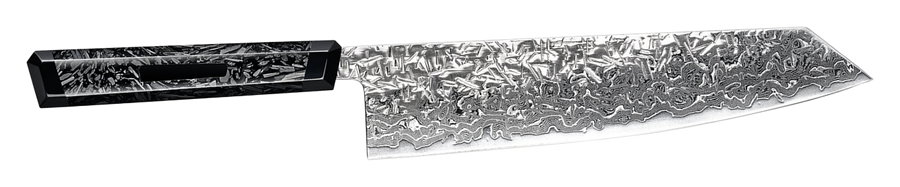
 Marea · Damascus Cleaver 7.5"$99
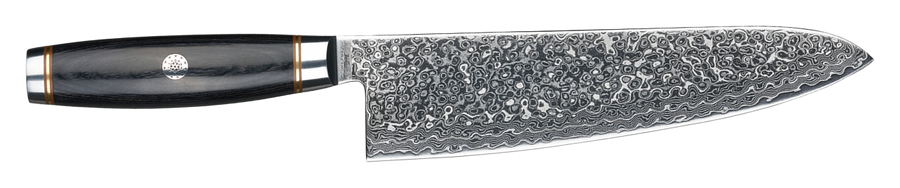
 Cobalt · Damascus Cleaver 7.5"$99
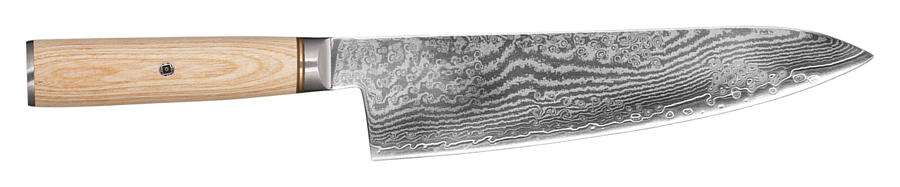
 Carmin · Damascus Cleaver 7.5"$99
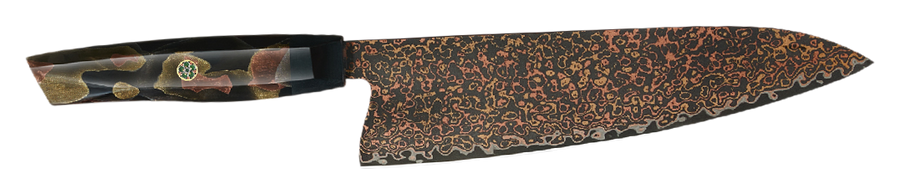
 Iris · Damascus Cleaver 7.5"$139
How do you care for a Damascus cleaver?
A Damascus cleaver is cared for like a chef's knife: hand wash in warm water, dry right away, never the dishwasher, cut on wood or plastic boards. Its large blade surface dries more slowly than a narrow blade, so wipe both sides as soon as you finish cutting.
Do not scrape food across the board with the edge: flip the blade and use the spine, or slide the flat underneath. Store the cleaver on a magnetic strip or in a block wide enough for it; a tall blade does not belong loose in a drawer. For sharpening, a 1000 grit whetstone rebuilds the edge, as the product page says; the full method is in how to care for and sharpen a Damascus knife.
A cleaver also makes an unexpected holiday gift for anyone who cooks a lot in a wok. For Christmas delivery in the US, order by Tuesday, December 1. More ideas are in our guide giving a knife as a gift.
Frequently asked questions
What is the difference between a Chinese cleaver and a meat cleaver?
Both have a tall rectangular blade, but a Chinese cleaver is thin, sharp and used like a chef's knife for vegetables, herbs and boneless meat. A meat cleaver is thick and heavy, with a blunter edge, and splits bone with the force of the chop. Most meat cleavers measure 3 to 6 mm at the spine, according to America's Test Kitchen.
Can a Chinese cleaver cut through bone?
A thin Chinese cleaver should not be swung into hard bone, or the edge will chip. All-purpose choppers can handle thin, soft bones such as poultry or fish. Damascus Knife cleavers handle cartilage and small soft bones, according to their product pages; for large hard bones, use a saw or a thick meat cleaver.
What is a cleaver knife used for?
A Chinese-style cleaver handles most prep: slicing and dicing vegetables, mincing herbs, garlic and ginger, cutting boneless meat and fish into strips, smashing garlic with the flat of the blade and scooping food into the pan or wok. A meat cleaver is used for chopping bone-in meat, ribs and joints.
Is a cleaver better than a chef's knife?
Neither is better; they suit different cutting styles. A Chinese cleaver is taller and heavier, push-cuts and chops well and scoops food up, but has no tip. A chef's knife has a pointed tip and a curved belly for rock chopping and detail work. In the Damascus Knife Cobalt series, the cleaver weighs 9.3 oz and the chef's knife 7.1 oz, with the same 2 mm spine.
How heavy should a cleaver be?
It depends on the job. A Chinese-style cleaver for everyday cooking stays close to a slightly heavy chef's knife: Damascus Knife 7.5 inch cleavers weigh 9.3 oz (Cobalt, Carmin) and 10.4 oz (Iris). A bone cleaver is heavier: America's Test Kitchen preferred models around 14 to 15 oz for chopping chicken and duck.
How much does a Damascus cleaver cost?
According to the Damascus Knife Price Survey (October 2026, 29 cleavers from US direct-to-consumer stores), a Damascus cleaver sells for a median of $129.99, with the middle half of listings between $119 and $169.99. At Damascus Knife, the 7.5 inch cleaver costs $99 in the Marea, Cobalt and Carmin series and $139 in Iris.
Sources
Updated November 4, 2026 · Method: weights, lengths and spine thickness from the Damascus Knife catalog product pages; median prices from the Damascus Knife Price Survey of October 21, 2026, 29 Damascus cleavers among 529 US listings.