






In short
- A boning knife separates meat from bone: chicken and turkey thighs, a leg of lamb, a pork shoulder. It also trims sinew, fat and silverskin.
- The blade is narrow, pointed and short: 6 inches is the median across US damascus listings; Damascus Knife makes 5.5 and 6 inch models.
- A fillet knife is longer and more flexible, built for fish; a butcher knife is wide and long, built to break down and portion big cuts. None of the three cuts through heavy bone.
- The basic technique: tip against the bone, short strokes, your free hand pulling the meat away, never twisting the blade.
- According to the Damascus Knife Price Survey (October 2026, 30 US listings), a damascus boning knife sells for a median of $119; ours cost $79 and $99.
A boning knife is used to take raw meat off the bone by following the bone instead of cutting through it: poultry, leg of lamb, pork shoulder, ribs, plus trimming sinew and fat. Its narrow, pointed 5 to 6.5 inch blade gets into joints where a chef's knife is too wide; for thin flatfish a more flexible fillet knife is easier, and for portioning a large roast you want a butcher knife.
What is a boning knife used for?
A boning knife is used to remove bones from raw meat while staying in contact with the bone, so you lose as little meat as possible. It is also the trimming knife: taking off sinew, fat and the shiny silverskin on a tenderloin. The narrow, pointed blade slips into joints where a wider blade gets stuck.
In a home kitchen the jobs are straightforward: boning chicken thighs to stuff or grill flat, taking the breasts off a whole chicken, removing the bone from a leg of lamb or a pork shoulder before rolling and tying it, cleaning a rack of pork. The same knife trims a beef tenderloin or a duck breast. Around Thanksgiving, it is the knife that takes a turkey thigh off the bone for a rolled roast.
Wikipedia's entry on the boning knife gives a typical length of 12 to 17 cm (5 to 6.5 inches) and describes a much narrower blade than other kitchen knives, which makes deep cuts around the bone easier. Our own market data matches: across the 28 US damascus listings that state a length, the median boning knife is 6 inches, and half of them fall between 6 and 7 inches.
A boning knife does not cut bone. It goes around it, separates the tendons at the joint and leaves the bone whole. A poultry joint gives way; a lamb leg bone never does. For heavy bone, you need a bone saw.
Boning knife vs fillet knife vs butcher knife
The boning knife, the fillet knife and the butcher knife all work raw meat or fish, but at different steps. The butcher knife breaks down and portions large cuts, the boning knife takes meat off the bone, and the fillet knife, with its long and flexible blade, lifts fish fillets off the frame and the skin.
| Feature | Boning knife | Fillet knife | Butcher knife |
|---|---|---|---|
| Main job | Following the bone, deboning, trimming | Filleting fish, skinning | Breaking down, separating muscles, portioning roasts and steaks |
| Typical blade length | 5 to 6.5 in | 6 to 11 in | Long (9 in on our Iris model) |
| Shape | Narrow, pointed | Very thin, long | Wide, long, upswept tip |
| Flex | Stiff or flexible, depending on the model | Flexible (that is the point) | Little: the width keeps the blade straight |
| Cuts bone? | No, it goes around it | No | No (use a cleaver or a saw) |
| At Damascus Knife | Marea, Cobalt, Carmin 5.5 in ($79), Iris 6 in ($99) | Not in our catalog | Iris 9 in ($129) |
Wikipedia describes the fillet knife as a very flexible member of the boning knife family, with blades of 6 to 11 inches. The flex lets it bend along the backbone and slide under the skin. The same source notes that a stiff boning knife is better for beef and pork, while a more flexible one is preferred for poultry and fish.
The butcher knife is the breaking-down tool. Our product page for the Iris 9 inch butcher knife lists its jobs: trimming a rib roast, separating the muscles of a shoulder, portioning roasts or steaks, in one long stroke. At 230 g (8.1 oz) with a 9 inch blade, it weighs more than twice as much as our boning knives (100 to 110 g, 3.5 to 3.9 oz).
For small, soft bones and cartilage (wings, poultry ribs), the right tool is a cleaver. Our 7.5 inch cleavers handle them, according to their product pages; for thick, hard bones a saw is the only answer, because a hard blow can chip the edge.
Can you fillet fish with a boning knife?
A boning knife fillets medium round fish without trouble: trout, sea bass, snapper, mackerel, salmon portions. On thin flatfish such as flounder or sole, a longer and more flexible fillet knife follows the bones and the skin more easily.
The reverse works less well: a flexible fillet knife is not made to bone a leg of lamb or a pork shoulder. The blade bends exactly where you need to push against the bone and cut a tendon. If you want one knife for both meat and fish, the boning knife is the more versatile choice.
Our boning knife product pages say the same thing: yes for filleting, and for very thin fish a more flexible fillet-style blade is more comfortable.
How to use a boning knife: the basics
Boning comes down to four rules: keep the tip and the edge against the bone, use short strokes instead of one long pass, pull the meat taut with your free hand so you can see where to cut, and never pry with the blade or twist it inside a joint.
- Find the bone before you cut. Feel along it with your finger and open the meat above it along its full length.
- Cut in small strokes, with the tip and the first 1 to 1.5 inches of the edge against the bone. The blade scrapes the bone more than it slices meat.
- Pull the freed meat toward you with your other hand: the tension opens the cut and shows the way.
- At a joint, find the gap and cut the tendons holding it. Do not force through the bone and do not use the blade as a lever.
- To trim silverskin, slide the tip under it, angle the blade slightly up toward the membrane, and pull the loose end tight with your other hand.
Two grips are common. The standard pinch grip, thumb and index finger on the blade just ahead of the handle, gives precision for trimming. The dagger grip, fist closed with the tip pointing down, helps on large cuts when you pull toward yourself to free the bone. Either way, cut away from the hand holding the meat.
A hard blade like ours (60 ± 2 HRC, as stated by the manufacturer) cuts cleanly and holds its edge, but it does not like sideways force. Twisting in a joint and forcing against hard bone are the classic causes of a chipped edge. If the blade sticks, recut instead of pushing.
On hygiene: wash the knife and the board in hot, soapy water as soon as you finish with raw poultry, before anything else touches them.
How to choose a boning knife
Choosing a boning knife comes down to four points: a 5 to 6.5 inch blade for home cooking, a narrow and pointed profile, a stiffness that fits what you bone most often, and a handle that stays secure when your hands are greasy. A good damascus boning knife costs less than a chef's knife.
- Length: 5.5 to 6 inches covers poultry, lamb and pork. Longer blades mostly help on large beef cuts.
- Stiffness: stiff for beef, pork and lamb; more flexible if you mostly work poultry and fish.
- Thickness: a thin blade gets in more easily. Our boning knives measure 2 mm (0.08 in) at the spine for Cobalt and Carmin and 2.2 mm (0.09 in) for Iris, per their product pages.
- Handle: raw meat makes hands greasy. A round burl wood and resin handle (Marea, Cobalt, Carmin) or abalone set in resin with a steel bolster (Iris) gives a good hold, but dry your hands between cuts.
- Steel: a blade that is often wet and in contact with blood calls for stainless steel. All 56 Damascus Knife models have a stainless 10Cr15CoMoV core; our boning knives have 67 layers, as stated by the manufacturer.

| Model (Damascus Knife catalog) | Blade | Overall length | Weight | Handle | Price |
|---|---|---|---|---|---|
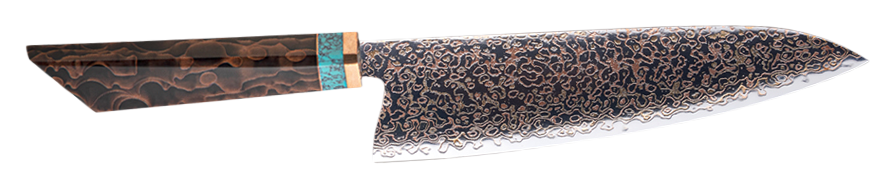
| Marea · boning knife | 5.5 in | not listed | not listed | Burl wood and blue resin | $79 |
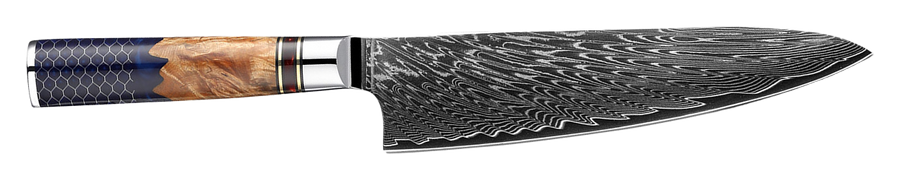
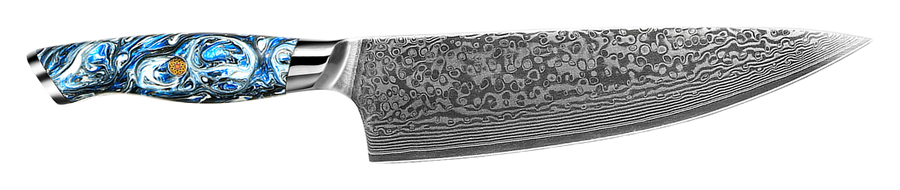
| Cobalt · boning knife | 5.5 in | 10.6 in | 3.5 oz (100 g) | Burl wood and midnight blue resin | $79 |
| Carmin · boning knife | 5.5 in | 10.6 in | 3.5 oz (100 g) | Burl wood and red resin | $79 |
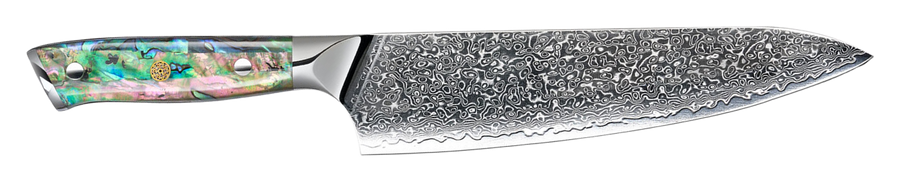
| Iris · boning knife | 6 in | 10.6 in | 3.9 oz (110 g) | Abalone shell in resin | $99 |
| Iris · butcher knife | 9 in | 14.4 in | 8.1 oz (230 g) | Abalone shell in resin | $129 |
All of these are in our damascus meat knives collection, alongside the cleavers and slicing knives. If you do not own an all-purpose knife yet, start there instead: our guide santoku vs chef knife helps you pick one.
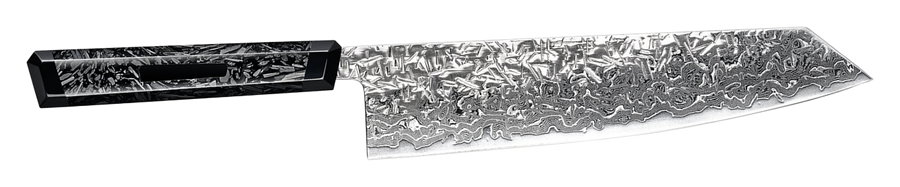
 Marea · Damascus Boning Knife 5.5"$79
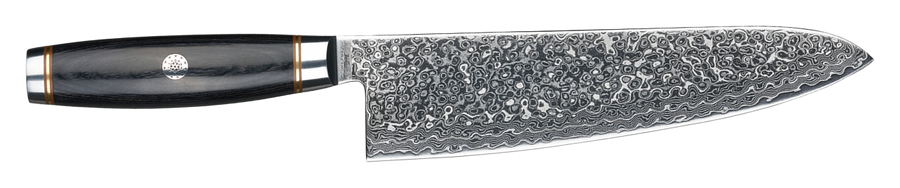
 Iris · Damascus Boning Knife 6"$99
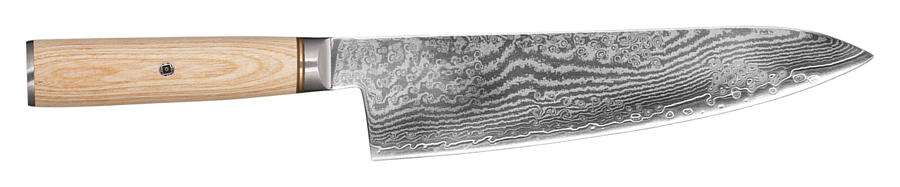
 Carmin · Damascus Boning Knife 5.5"$79
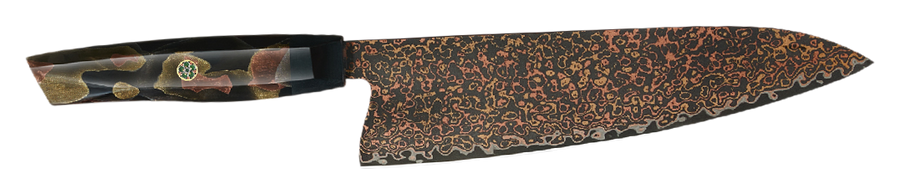
 Iris · Damascus Butcher Knife 9"$129
How much does a damascus boning knife cost?
A damascus boning knife sells for a median of $119 in the US, according to the Damascus Knife Price Survey (October 2026, 30 listings from 9 stores). That is below the $149 median for a damascus chef's knife of about 8 inches, because the blade is short and narrow.
Damascus Knife Price Survey · October 2026
Survey of displayed prices on October 21, 2026, for damascus kitchen knives sold individually by 15 US direct-to-consumer stores (529 listings), including 30 boning knives. Median $119, lower quartile $85.99, upper quartile $139. 27 of 30 listings (90%) are priced at $79 or more; 18 of 30 (60%) at $99 or more. Median blade length 6 inches (28 listings with a stated length).
At Damascus Knife, the boning knife costs $79 in the Marea, Cobalt and Carmin series and $99 in the Iris series, with free tracked shipping and import duties included: both prices are below the US market median. The Iris 9 inch butcher knife costs $129.
Prices by knife type and steel are broken down in our guide how much a good damascus knife costs, and what 37 and 67 layers mean in damascus knife steel and layers. For a holiday gift, order by Tuesday, December 1.
How do you care for a boning knife?
A boning knife needs the same care as any thin blade: hand wash right after use, dry it immediately, never put it in the dishwasher, and store it so the tip is protected. Fat and blood dry fast on steel, so do not leave the knife sitting on the board once you are done.
The tip is the most exposed part of a boning knife, since it is the part that touches bone. Run the blade over a honing rod when it starts catching less cleanly under silverskin, and use a whetstone when honing no longer brings it back. A sharp edge takes less force, which means fewer slips.
The full method (honing rod or whetstone, grits, angle) is in our guide how to care for and sharpen a damascus knife.
Frequently asked questions
What is the difference between a boning knife and a fillet knife?
A boning knife has a short, narrow and fairly stiff blade made to follow the bone in meat and poultry and cut tendons at the joints. A fillet knife is longer, typically 6 to 11 inches, thin and flexible, so it bends along the backbone and slides under fish skin. A boning knife can fillet round fish; a fillet knife bones a leg of lamb poorly.
What size boning knife do I need?
For home cooking, a 5.5 to 6 inch blade covers poultry, lamb and pork. According to the Damascus Knife Price Survey (October 2026), damascus boning knives sold in the US have a median blade length of 6 inches across 28 listings. Longer blades mostly help with large beef cuts broken down by butchers.
Should a boning knife be stiff or flexible?
A stiff blade is better for beef, pork and lamb: it presses against the bone without bending and cuts tendons at the joints. A more flexible blade is preferred for poultry and fish, whose bones are thinner and more curved. If you mostly work meat and only sometimes fish, choose a stiff blade.
Can a boning knife cut through bone?
No. A boning knife goes around the bone and cuts the tendons holding a joint, but it does not cut bone. Prying or twisting inside a joint is the classic way to snap a tip or chip an edge. For cartilage and small soft bones, use a cleaver; for heavy bones, a saw.
What is a Japanese boning knife called?
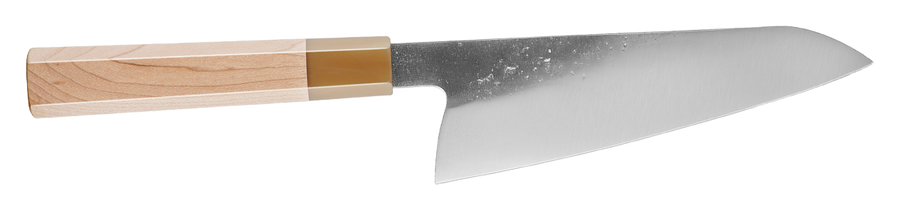
A Japanese boning knife is called a honesuki. It has a short, stiff, triangular blade and is mainly used to break down and bone poultry. The Damascus Knife boning knives are Japanese-style but have a narrow, pointed blade rather than the triangular honesuki shape.
Updated November 4, 2026 · Method: specs from the Damascus Knife catalog product pages (lengths, blade thickness, weight); median prices from the Damascus Knife Price Survey of October 21, 2026, 529 US listings including 30 boning knives.